Find me
THE DEVELOPMENTAL ASPECTS OF SEXUAL HEALTH LABORATORY
  • Home
  • People
  • Research Projects
  • Blog
  • Publications
  • Presentations

Drafty drafts

1/24/2016

0 Comments

 
When you’re working on a paper of some sort (class paper, thesis, manuscript), how do you approach it? Do you agonize over every word and sentence and paragraph as you go? Or do you work to push through relatively quickly, leaving holes as you get stuck on things?
 
I used to do the former.  I would start a manuscript with paragraph one. I would take an inordinate amount of time agonizing over that paragraph in particular, to get the perfect first sentence, and perfect first paragraph. As I went through, if I wanted to cite something to make a particular point in a sentence, I would pause from writing and track down that reference immediately. If I struggled over an idea or thought, I would stay with that paragraph/idea until I could hash out at least some form of a draft of that paragraph.
 
I have modified this style slowly over time. Now, if you look at a draft of a paper I’m working on, it will have multiple comments and/or statements in bold. So, instead of getting stuck, I will skip over a sticking point and come back to it later. I often don’t even attempt to tackle the first paragraph until the rest of the introduction is done. And sometimes I outline the introduction, paragraph by paragraph, and write out the hypotheses, but don’t fill in the line by line details of the introduction until I’ve drafted the methods and results.
 
Now I allow holes in the draft (drafty drafts) in order to keep moving through it, rather than pausing to fix every detail. So, opening up some current in progress manuscripts, they include some of the following comments:
  • Do we need more of a transition here? Probably…
  • (CITE)
  • (CITES OF LOW % AT YOUNG AGE)
  • Religiosity:  FIND ANYTHING ON KISSING? AND THEN IF NOT, GO TO LIFETIME VAGINAL SEX
  • MORE HERE ON WHY THIS MATTERS???
  • Despite these limitations, this paper provides… WRITE A CONCLUDING PARAGRAPH!!!
  • SAY MORE HERE ABOUT WHY THIS IS INTERESTING.
  • (AH, FIX THIS SENTENCE!).
  • ORAL SEX MATTER? THEY ARE REINFORCIING – SEE TALK FOR THIS, BUT BASICALLY, IF ORAL SEX IS LESS POSITIVELY PERCEIVED, MAY BE MORE LIKELY TO ENGAGE IN VAGINAL IN FUTURE, WHICH CARRIES EVEN MORE RISK
The point is, rather than getting stuck on trying to explain why oral sex matters, if I’m really stuck on that issue in the moment, I can move onto the next paragraph, and return to it later with fresh eyes.
 
I’ve been collaborating with someone new over the past couple of years, and his style is quite different. He will send a draft around with fairly significant gaps in it. Often he sends it before the discussion is touched, and often there are holes in the manuscript, either where he’s asking for help/advice, or where he wants to return to later, but he wants input from others on other sections first. Sometimes I’ve tried to follow his lead, in terms of allowing my draft to be draftier when I send it to co-authors. In the past, no matter what order I worked on things, I didn’t send the paper to co-authors until I had a full, relatively solid draft. Now, I should pause to note that if you’re a student working on a thesis or a manuscript with your adviser, it’s unlikely you will draft a full manuscript before sharing with your mentor. I usually have my students share their manuscripts (and theses and dissertations) in stages so I can have input before they have written too much (and potentially wasted a lot of time down the wrong path).
 
By emulating my collaborator and sending drafts around at earlier stages, I find that the back-and-forth pushes me to get moving more quickly, and the early input can help shape sections that I might have had to rewrite more drastically later. Also, some section I’m struggling with may come more easily for a co-author. So if you open up drafts I recently shared with co-authors, they contain some of the following comments:
  • You’ll notice reading through that I haven’t really settled on a term to refer to this age period. Once we pick one I promise I’ll use it consistently.
  • At this point reading through, ignore APA style for et al as I tried to mostly write things out in case order changes or earlier references get dropped. 
  • WHAT ELSE CAN WE PUT HERE? DRINKING SODA (KIND OF KIDDING); RISKY DRIVING? TANNING?
  • OTHER BETTER IDEAS HERE?
 
By allowing myself to have drafty drafts, rather than letting perfectionistic-Eva take over and agonize over the placement of every word, I increase my efficiency. And fresh-eyes-Eva often can tackle the problem that tripped up yesterday-Eva.
 
“The post Drafty drafts first appeared on Eva Lefkowitz’s blog on January 24, 2016.

0 Comments

Mechanics of writing a manuscript

11/17/2015

0 Comments

 
Every Spring semester, I lose control right around the end of Spring break/SRCD and then reemerge around May. So hello.

Thus, Summer Eva will be catching us up on what we covered in the Spring in Adolescent Development and in Professional Development.  (NOTE: I drafted this post in May, but somehow lost control of the blog again in the Spring, so hello. Again).

Today, I’m covering the mechanisms of writing a manuscript. We have already reviewed choosing a journal. And for my advice on the specifics of writing, see my intentional writing series.

Tailor to the journal (when possible). Something authors often do is write a manuscript, decide where to submit it, and then go back through to make it fit that journal better – add more adolescent development theory if it’s an adolescent journal; add a prevention spin if it’s a prevention journal; shorten it if the word limit is less than the manuscript, etc. If, on the other hand, you can decide on the journal in advance, then you can tailor the manuscript to that journal to begin with, keeping the journal’s focus, criteria, and word limit in account from the beginning.

Hourglass shape. [Insert bad joke here about how we all want to obtain an hourglass shape].

​ 
Picture
I learned this analogy in grad school, and somehow assumed that everyone else did too, but recently learned that it’s not universally taught. So, think of your manuscript/journal article as an hourglass. It starts broad/wide, gets narrower and narrower, and then widens out again. At the start, the introduction starts broad and narrows: it starts with larger/big picture ideas to show how your ideas relate to larger issues. You then move to theory, and then to prior empirical work, before stating your specific hypotheses. Your methods and results are the narrowest because they explain exactly what you did, and what you found. Then your discussion is the opposite of the introduction, because it starts relatively narrow with a summary of your results, moves broader in situating your results in the larger literature, then how your results address theory, and then finally, broader conclusions and implications.

First sentence and abstract. Intentional writing is important for your entire manuscript, but even more so in the first sentence and abstract. Many people will only read your abstract – or will use it to decide whether to keep reading. Be clear, so that if someone only reads the abstract, s/he will know exactly what you did, how, and why. And don’t bore them. Elsewhere I’ve discussed the importance of the first sentence and starting strong: make the reader excited about what you have to say next.

First page. Your first page should summarize why your study matters, and what you plan to do (White, 2005). Sometimes authors work so hard to build a case for their study that they forget to start with the summary of the case. As White says, “Too many authors wait until p. 13 to tell the reader whether they have 20 or 10,000 cases.” (2005, p. 792). Not that many readers will make it to page 13 if you don’t tell them why they should bother.

Literature review. Unless your paper is actually a literature review, it should not summarize everything that has ever been done before in this area (White, 2005). Choose key citations to make your points, and present all sides of an issue, but do not try for a comprehensive literature review in an empirical paper.

Headings. Use them.

Discussion. One frequent mistake I see as a reviewer is when authors write paragraph after paragraph interpreting their findings, without situating it within prior literature or theory. A good rule of thumb is to make sure that you have citations in just about every single paragraph in your discussion, and that the citations are not only to your (or your adviser’s) work. By the end of the discussion, readers should have a strong understanding of your contribution to the literature, both in terms of building on prior empirical work, and addressing theoretical questions. 

“Every sentence matters.” This quote is from my colleague Steve Zarit, one of the most prolific and well cited professors I know. Don’t waste space. Consider the importance of every sentence.

First draft. Get it out. Even though every sentence matters, every sentence does not matter in your first draft. Never let a sentence or a paragraph hold you up. Get through the whole paper, even if you have to use tricks like “INSERT SENTENCE ABOUT RATES OF CONDOM USE IN ORAL SEX HERE” or “SAY SOMETHING INTERESTING ABOUT WHY THIS MATTERS HERE.” Get through the whole draft, and then worry about tackling the sticking point details.

“The post Mechanics of writing a manuscript first appeared on Eva Lefkowitz’s blog on November 17, 2015.”
0 Comments

Great introductory sentences

11/3/2015

0 Comments

 
I've written before about starting with a strong and powerful introductory sentence.

This morning I am working on a lit review for a paper, and I came across a strong introductory sentence and thought, let me share all of the strong ones I come across this  morning (do you see where I'm headed yet?). I had 24 papers to read through, and found 2 where I thought the first sentence was particularly noteworthy. Many of the others were interchangeable. And I wish I could share some of them here as examples of what not to do. But I'm too nice. So here are the two I liked:

In an era when sex is used to sell everything from toothpaste to transmissions, the idea that large minorities of adults might have little or no sexual contact with others seems incongruous to many people.  (Donnelly et al., 2001)

Over the past decade, a quiet revolution has been occurring in personality psychology, and an age-old scientific problem has recently begun to look tractable. (Goldberg, 1992)


0 Comments

Self-plagiarism

2/25/2015

0 Comments

 
Self-plagiarism

This is the second of three blog posts from one class in Professional and Ethical Development issues in which we talked about ethical issues in publishing and peer review. We discussed self-plagiarism, which in some ways has less clear boundaries than plagiarizing others’ work. However, I think there are some clear cut cases where most people would say the act was wrong:

  • Publishing an identical paper in two or more places
  • Writing the same paper from two courses without telling the instructor

Then there are times that most people would agree that it’s okay to self-plagiarize, such as:

  • Turning a thesis into a manuscript
  • Using text from a prior grant proposal in a new grant proposal
  • Repeating similar or even identical wording from part of a methods section that uses the same dataset, e.g., in explaining the sample, the procedures, or specific methods or measures (especially if we’re talking about a sentence here or there, not the full methods section).

We discussed some other issues, though, that are fuzzier.

  • Recycling parts of an introduction from a published paper in another paper.
  • Reusing text from a published paper in a new paper, where the authors aren’t identical (e.g., there was an author on the earlier paper who is not on the current one)
  • Using ideas from another paper that are not original because they’re published, but they are your own ideas.

And finally, we talked about a couple of things that students especially should try to avoid. One thing that can happen is that the influence of your mentor and her ideas can be really strong. You’ve talked about topics for years, and so you really internalize her perspective. And that’s great – I’m sure she’s happy you did. But then if you write about it, make sure that you accurately attribute it. Otherwise, you are implying that the ideas originated from you, when in fact, they are your advisor’s ideas that you agree with, but did not create yourself.

“The post Self-plagiarism first appeared on Eva Lefkowitz’s blog on February 25, 2015.”

0 Comments

Publishing perseverance

11/9/2014

0 Comments

 
Sometimes publishing takes a long time. Sometimes a paper you write doesn't hit the first, second, or even third place you submit it.  Sometimes, the only way you get a paper published (or a grant funded) is by perseverance and the inability to give up in the face of rejection.

Yes, it's time for another confession. It's one that I am finding hard to make as I sit here writing it (I keep pausing and asking myself, do you really want to put this out there?). But my own discomfort sharing it provides evidence that it's important for me to share this experience with graduate students and other young professionals. I heard this week that a paper that I wrote is now in print.  I could pretend that this paper is published in the journal I submitted it to, and that it was a straightforward and easy process, but it wasn't. It was first submitted 8 years ago, and it was rejected from 4 other journals before it was published in its current location.

There are a number of reasons that this happened. I aimed high on the first submission, and after a long review process, it was rejected, actually on the day my children were born. The intervening years include periods of time where I was busy with other projects, including data collection and new manuscripts and didn't return to this paper;  a 2 year period  where it went through three rounds of revision, at which point the editor asked for completely new analyses and new variables that were not central to the paper, so we withdrew it. Last fall, while on sabbatical, I had a chunk of time to rework it, and sent it to a new journal, where we had a very positive review process, an R&R,  an acceptance soon after, and then this week, it was published.

The reason I persevered is that I had faith in the paper. It wasn't the most life changing paper ever, but I thought it was strong and interesting. Obviously, if I didn't have faith in it, or if reviewers pointed out something fatal, I should have given up. But when we received reviews, we were able to address concerns, and send it somewhere new. In the end, the perseverance paid off. Sometimes, it's an issue of fit, and you eventually find the right home for a paper.

In my research group, we have a "paper tracking sheet" that we update 3 times per year. For paper that are in progress or submitted, we have information about when and where we intend to submit it, and journal names and dates of any prior submissions. Sometimes, we miss our target submission dates. Sometimes even by years. But once that paper is accepted, it moves to the "in press" section of the document, and the history disappears from the document.

Again, I'm not saying that every paper requires perseverance. Some papers find their homes on the first or second try. And honestly, on the reviewing  end, I've read manuscripts that probably should never be published anywhere, even with new frameworks or new analyses. But my point is, just like the late blooming adolescent, sometimes, for a number of reasons, a paper may take a bit longer to find its home, and in the end, that line on your CV doesn't mean anything different than any other line... at least to anyone but you and your co-authors.
0 Comments

Time spent editing manuscripts (and other things keeping me away from blog posts)

7/9/2014

0 Comments

 
I had this vision that summer would bring an increase in my blog writing. I would write a new post 5 days a week, post them 2 days a week, and come fall, I would have a great store of written posts that I could use to fill in the weeks I didn't have time to write. You know where this is going, right?

There are no back-up posts. There is a list of blog ideas, and that's it. The list grows; the back up posts do not.

On sabbatical, I vowed to bring sabbatical thinking more to my summers.  As many people know, most faculty are not paid in summer, although we are expected to get work done in summer (although I did recently receive the facebook comment, "
You work in the summer?") I have a part administrative position so I have a requirement of a certain number of hours for that.  I am trying to get some bigger writing projects done in the summer. And of course, everyone else is trying to get writing done in the summer, so I have a back log (so much worse than back-up posts!) of other people's work I owe feedback on.

I've been mildly successful with sabbatical thinking. I have been working from home more. Evidence that I rarely do so was the recent email I received to "get better soon!" when I told our administrative assistant I would be working from home for the second day in a row, if she needed me.

All of this preamble is to say: Working from home more; getting some writing done; mostly working on other people's stuff.

In some recent conversations, people have said things like, "how long does it really take to read someone else's paper?" A legitimate question. So I decided to start tracking it given how much of my summer has been engaged in this very act. My conclusion: I just about never spend less than 3 hours on someone else's manuscript (or thesis). I can easily spend 4-5 hours on someone else's manuscript (or thesis). And, if the manuscript is a revision, and thus also includes a letter to the editor, I may spend a bit longer.

Now I'm a bit of a perfectionist (this poorly written at 1:00 AM blog post notwithstanding), and so I do spend a fair bit of time microediting. But it would be great to get data from others about how long you spend reading/editing co-authored manuscripts. Please share in the comments.

“The post Time spent editing other people's manuscripts (and other things keeping me away from blog posts)  first appeared on Eva Lefkowitz’s blog on July 11, 2014.”
0 Comments

Writing marathon

6/9/2014

0 Comments

 
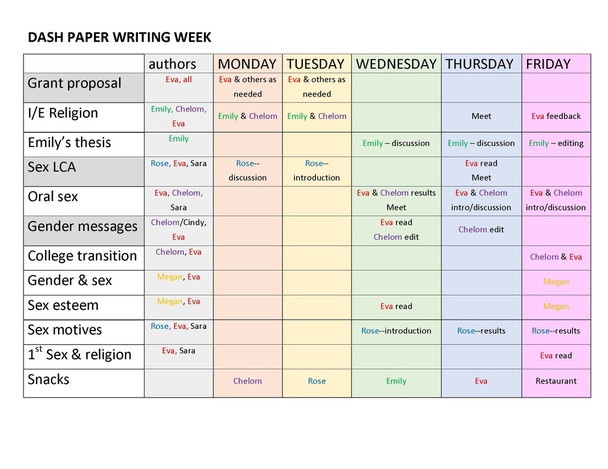
I mentioned in a previous post that we had a grant writing marathon for 3 days in May. It was an excellent experience for me, in that my 3 students spent those 3 days basically supporting me in various grant related tasks. We had also scheduled a full week in June for paper writing. It turned out that I didn’t need to submit my proposal until late Tuesday of last week, so Monday and Tuesday were still grant writing for me (and a bit of support from my students), but otherwise, we all worked on various manuscripts (and 1 thesis). Here is the line up:

Picture
So we worked on 1 grant proposal, 1 thesis, and 8 manuscripts in various stages ranging from conceptualization, to responding to an R&R (note: fully drafted doesn’t mean it started from nothing!).

The end of the week tally was:
1 grant proposal: Submitted!
1 thesis: fully drafted and in my inbox
2 papers: analyses finalized and partially drafted
2 papers: revision & accompanying letter fully drafted and feedback given
3 papers: fully drafted & feedback given
1 paper: analyses run but more to go

If I hadn’t spent so much time on the grant proposal (both during our group time and late each night), I’m sure I could have accomplished more than I did on the paper I’m primary author on, though I did make some progress there. However, my biggest accomplishments of the week (other than, did I mention, the grant proposal?) was giving feedback to students and other co-authors on 4 papers, and meeting with students about other papers.

Overall we were generally happy with the week. It generated a fair bit of conversation in the department as people came by to see what we were up to. And we all agreed that when my lab space is next door to my office in our future building we are going to be more productive together (drop the lag time between sending emails and replying to them). The verdict was mixed on whether 5 days was the ideal – some people thought it was too long, and others liked it and were ready to schedule the next marathon. We may try for mini-marathons – either one day, or paper specific or both – in the next couple of summer months.

Couple of other observations – one of my students fashioned herself a standing desk and seemed to really like that. We had snacks every day and went out to lunch on Friday which helped morale, though morale likely would have been higher if, like Cindy Berg, we had a better setting than a window-less conference room.

But generally, we all really liked being near each other, and all engaged in the writing process. The collaboration was excellent, too, knowing we were involved in similar activities and able to check in with each other throughout the day.

Have you ever tried something similar? What worked about it and what would you change?

“Writing marathon first appeared on Eva Lefkowitz’s blog on June 9, 2014.”

0 Comments

Word trick #1: Merging tracked changes and comments

5/29/2014

0 Comments

 
Last week we had our grant writing marathon. On the final day, my 3 students each read a 20 page, single spaced (0.5 inch margin!) document to give feedback. The feedback totaled about 900 revisions. One student suggested creating a google doc to work from simultaneously, but I worried about working on sections at the same time, and about loss of formatting in the conversion.

Nervously, I went with merging track changes and comments in Word. It mostly worked, creating one document with everyone’s comments combined. You can find details about how to do it here.

In brief:

·         Choose compare from the Review tab

·         Choose combine revisions from multiple authors

·         Choose an original and a revised version

·         You can choose what you do and do not want to compare/merge, and how to do it

·         Repeat as many times as necessary depending on how many people worked on the document

I ended up with one document that had everyone’s tracked changes, plus everyone’s comments, in one place. Magic.

I would do one thing differently. I didn’t learn until I had everyone’s feedback that Word will not merge formatting edits from multiple documents, so it lost everyone’s formatting edits. It wasn’t a huge deal, because we weren’t doing careful formatting reads this time (e.g., fixing indents, fixing bold vs. underline). However, if I did it again, I would ask all readers not to make any formatting changes, but instead, to make comments as to where they thought formatting changes should be made (e.g., highlight text and write in comment “should be bold.”).

Either way, much better than trying to go through 900 revisions across 3 documents. Thank you everyone!

“The post Word trick #1: Merging tracked changes and comments first appeared on Eva Lefkowitz’s blog on May 29, 2014.”

0 Comments

Grant writing marathon

5/27/2014

4 Comments

 
My students and I had a 3-day grant writing marathon. It’s the first time I’ve ever done something like it, and I’m a total convert and want to convince the rest of the world how fabulous it is.

I got the idea from Cindy Berg, who holds an annual writing retreat with her research group. Toward the end of Spring semester this year, my students and I scheduled a 3-day period and a 5-day period. 

I recently decided to aim for a June 5 instead of an October 5 grant writing deadline. I had been thinking, October 5! Then I have the whole summer to write this proposal. But I hate writing grant proposals. It is a huge writer’s block issue for me, and I have been working on the same proposal for way longer than I will admit in writing. So I finally had an aha! moment where I realized that if I aim for October 5, then I actually have the whole summer NOT to write the proposal, while the proposal gets in the way of all of my other writing. So I committed to June 5, with the goal that it is out at the start of the summer, and then I have the rest of the summer for paper writing. The other advantage of June 5 is that after classes end, May often disappears and I don’t really know what I accomplished, so the proposal becomes a clear May accomplishment.

My three current students and I blocked off Monday – Wednesday, 9:00 AM – 4:00 PM of last week for proposal writing. I crammed all of my meetings for that week into Thursday (Fridays I generally don’t come into the office) and we claimed the conference room across the hall from my office (my lab space is 2 flights away from my office, not ideal for interactive collaboration).

It’s hard to convey how well this process worked for me/us. We certainly didn’t start from scratch, so I’m not saying that we wrote a whole proposal start to finish in 3 days. I had drafts of most sections by the start of Monday, in part with help from the students and some other collaborators prior to the scheduled days. On Monday and Tuesday, I mostly assigned people specific tasks related to holes in the proposal, e.g.: write a couple of specific paragraphs/sentences to beef up some sections; find literature to support specific points; work on the reference list; add details on measures or find new measures to address certain points; find relevant program announcements; fill out the enrollment chart; run frequencies on specific variables to add to proposal; take a first pass at some supporting sections, like resource plan or budget justification, so that I had a start or outline to work with.

On Wednesday morning, I sent around the full draft for everyone to read. Everyone sent feedback by the end of the day. Wednesday night I read through all of the feedback (about 900 revisions in the 20 or so pages), made edits, and then sent some final follow-up questions based on everyone’s feedback. Everyone had replied to me by the end of the day Thursday (technically not one of the grant writing days), and I was able to share with the other investigators for their feedback.

Reasons why I think it worked/what was great about it:

·         We all had blocked off the time to work on it. Perhaps it goes without saying that blocking off the time means that we all concentrated on the proposal and not other tasks in our lives. This distinction was huge for me, because I tend to reply to things immediately and drop what I’m working on to respond to things in real time. For these 3 days, I mostly ignored emails that weren’t urgent. When my department head emailed me and asked if we could talk by phone about something that day, I replied, asked if it was urgent, and said if it was not urgent, could we wait until the next day. We could I never, ever say things like that to people, so it was a big step for me to prioritize my own research over an administrative responsibility.

·         As I told my colleague, it was the first time in 3 years that I mostly neglected my Professor-in-Charge (PIC) duties for 3 straight days. And the world didn’t end. I did reply to a few urgent emails, but left the non-urgent tasks for Thursday and beyond. It was a good lesson to me of the value of occasionally stepping away from the tasks that are always there and never really finished.

·         Being physically together – and knowing we were all working on the same task – was important for all of us. It really reduced response time and ability to check in about things. When my students had questions for me, they could come across the hall and ask me. Because the lab is 2 flights of stairs away, they never, ever pop in with questions. They always email me, and that obviously requires some delay in response time. Instead, I could answer their questions immediately. Similarly, I could ask them questions right away; give them a new task right away; or approach the group with a conceptual question I was struggling with, rather than waiting until our next lab meeting to do so. Currently, given my office location, departmental staff I work with pop in regularly with questions related to my administrative role, and that works well. I now look forward to moving to our new building in 14 months where my lab space will be next door to my office.

·         The other advantage of being physically together is it made it harder to goof off. I didn’t want someone to walk into my office and see me surfing the web. One of my students in particular said that she really liked working with me nearby because it kept her on task and away from procrastinating, knowing I could walk in at any moment. She also said she looked forward to working near my office in the future for that very reason.

·         There were 3 students working on my tasks, and as a result, I constantly was scrambling to stay ahead of them to keep them in tasks. Someone was always popping in to say that they finished the last task, what next? That time pressure was excellent for keeping my momentum. Again, if we weren’t together with blocked off time, it would have been me, alone, slowly working through one thing, emailing it to someone, slowly working through something else, emailing it… instead, it was a constant back and forth of documents.

·         In the beginning, I really was thinking about the 3-days advantaging me and the proposal, and the students indirectly in that funding for the proposal would translate to student funding. It wasn’t until the last day that I realized the direct benefit to the students. They learned a fair bit about grant writing, what all the sections are about, what you need to highlight, how to edit it, etc. etc. By the end they said that they had learned a fair bit about proposal writing, and I think the intensity of the 3 days really made the process a better learning experience.

·         Snacks! One day a student brought in lunch for everyone. Each of the 3 days someone brought in dessert. On day 3 we needed a change of scenery so I took them out to lunch and we didn’t talk about the proposal. Food was good.

I have fabulous students, whom I genuinely like, so spending 3 days with them all day was invigorating and enjoyable. I am so grateful to all of them for dedicating this time to the proposal, and am really impressed with how much we accomplished in 3 days. I highly recommend trying something similar to anyone working on a grant proposal.

In June we have our one week paper writing marathon. Stay tuned.

“The post Grant writing marathon first appeared on Eva Lefkowitz’s blog on May 27, 2014.”

4 Comments

Writing an introduction: Integrate, don't list, past research

2/13/2014

0 Comments

 
I’m feeling particularly sensitive to hyperbole after days of listening to reports of snowmageddon/snowpocalypse, and also worry about the 18 students trying to fly/drive/bus to our prospective graduate weekend right now. In addition, there is a food blog I enjoy reading, but I’ve discovered over time that each of her posts is so hyperbolic, it is difficult to take her recommendation seriously. Every recipe she provides is the most delicious/amazing/it-will-change-your-life recipe. Now when she posts a new recipe, my enthusiasm is dampened, because they can’t ALL be the best way ever known to prepare chicken.

That said, I do think that if you are not already writing introductions the way I’m about to describe, it may actually change your life.

There is a tendency when writing an introduction to write about past research in a list. I see it in undergraduate papers, master’s theses, dissertations, manuscripts I review, and yes, published articles. It is not necessarily incorrect, nor is it terrible writing. However, it is another area where you can move to intentional writing, working harder as the author to make the reading easier for others. It is easier to write a list of past research, but it is easier to read a summary of past work that integrates across studies. Undergraduate students are more likely to have one paragraph or so per study, and writers with more experience tend to have a sentence or so per study. The sentences are often linked with phrases like “similarly,” “in contrast,” or “other work has also found.” But nevertheless, the writer leaves the work of drawing connections to the reader. When a writer does the integrative work for the reader, the reader can quickly arrive at the big picture of past work, and see how it relates to the authors’ own ideas.

Here’s an example. In this paper, I could list past work as follows:

College students are more likely to drink, and drink more heavily, on their 21st birthday compared to other days (Smith, Bogle, Talbott, Grant, & Castillo, 2006). Rutledge, Park, and Sher (2008), in a more representative study, found similar increases in drinking on 21st birthdays. Neal and Fromme (2007) found that alcohol use was elevated on holidays like New Year’s Eve, as well as on football weekends. Similarly, Del Boca, Darkes, Greenbaum, and Goldman (2004) found that alcohol use increases on New Year’s Eve and other holidays. Other researchers have also found elevated rates of drinking on Halloween and St. Patrick’s Day (Glindemann, Wiegand, & Geller, 2007). Another event with higher rates of drinking is Spring Break (Patrick, Morgan, Maggs, & Lefkowitz, 2011). Grekin, Sher, and Krull (2007) found that increased drinking during Spring break occurred only when students were with friends.

I find that paragraph really challenging to process, because the connections are rarely drawn for the reader. In contrast, here is the start of our paper as actually published (Lefkowitz, Patrick, Morgan, Bezemer, & Vasilenko, 2012):

College student alcohol use is known to increase during the celebration of special events such as 21st birthdays (Rutledge, Park, & Sher, 2008; Smith, Bogle, Talbott, Grant, & Castillo, 2006), football games (Neal & Fromme, 2007b), Spring Break (Grekin, Sher, & Krull, 2007; Patrick, Morgan, Maggs, & Lefkowitz, 2011), and holidays like Halloween and New Year’s Eve (Del Boca, Darkes, Greenbaum, & Goldman, 2004; Glindemann, Wiegand, & Geller, 2007).  

In the latter example, we have summarized across studies, integrating studies that have similar findings.

I’m not comfortable highlighting any examples of published work that is not well integrated, but if you look at 10 articles you have recently read, I guarantee you will find several that list rather than integrate. And here’s another example of well integrated writing, from Dalton and Galambos (2009):

Moving away from parents is a major task of the transition to adulthood. Although some studies have indicated an association of leaving home with less depression and better relations with parents during the transition to adulthood (Aseltine & Gore, 1993; Smetana, Metzger, & Campione-Barr, 2004), others have found that living away from parents was related to a significantly higher risk of binge eating (Barker & Galambos, 2007), more depression (Galambos & Krahn, 2008; Seiffge-Krenke, 2006), and higher alcohol use (Kuo et al., 2002). In any case, living away from parents creates opportunities to engage in sexual activities due to freedom from parental detection.

In this example, I particularly appreciate the way they have set up the “some studies have found X, whereas other studies have found Y” in an integrated way.

We recently discussed this writing issue in my graduate seminar. Some students expressed concern that when they summarize and integrate, they may misrepresent, or at a minimum, miss the nuances, of past research. Of course, you should never misrepresent someone else’s work, or selectively omit things that contradict your argument. However, it is okay if you don’t provide every detail of their work. If someone found that peer rejection was associated with anxiety, depression, and substance use, but your paper focuses on substance use, you don’t need to mention anxiety and depression.

There are other benefits to moving toward more integrated writing. You will find that you have a much better sense of past work when you force yourself to summarize rather than list. In addition, integrated writing often means fewer words, and who doesn’t want that?

“The post Writing an introduction: Integrate, don’t list, past research first appeared on Eva Lefkowitz’s blog on February 13, 2014.”

0 Comments
<<Previous
Forward>>

    Eva S. Lefkowitz

    I write about professional development issues (in HDFS and other areas), and occasionally sexuality research or other work-related topics. 

    Looking for a post doc? 
    List of HDFS-relevant post docs
    Looking for a fellowship? 
    List of HDFS relevant fellowships, scholarships, and grants
    Looking for an internship?
    List of HDFS-relevant internships
    Looking for a job?
    List of places to search for HDFS-relevant jobs

    Categories

    All
    Adolescent Development
    Being A Grad Student
    Conferences
    Excel
    Gmail
    Grant Proposals
    Job Market
    Mentoring
    Midcareer
    Networking
    PowerPoint
    Publishing
    Research
    Reviewing
    Sexual Health
    Social Media
    SPSS
    Teaching
    Theses & Dissertations
    Transitions
    Undergraduate Advice
    Word
    Work/life Balance
    Writing

    Archives

    February 2022
    May 2021
    January 2021
    July 2019
    June 2019
    May 2019
    January 2019
    November 2018
    October 2018
    September 2018
    August 2018
    July 2018
    June 2018
    May 2018
    March 2018
    October 2017
    November 2016
    June 2016
    May 2016
    April 2016
    February 2016
    January 2016
    December 2015
    November 2015
    May 2015
    March 2015
    February 2015
    January 2015
    December 2014
    November 2014
    October 2014
    September 2014
    August 2014
    July 2014
    June 2014
    May 2014
    April 2014
    March 2014
    February 2014
    January 2014
    December 2013
    November 2013
    October 2013

    Follow @evalefkowitz.bsky.social on Bluesky

    RSS Feed

    View my profile on LinkedIn

    Enter your email address:

    Delivered by FeedBurner

    Blogs I Read

    Female Science Professor

    The Professor is in

    APA Style Blog

    Thinking About Kids

    Tenure She Wrote

    Prof Hacker

    Andrew Gelman

    Claire Kamp Dush
Proudly powered by Weebly