Find me
THE DEVELOPMENTAL ASPECTS OF SEXUAL HEALTH LABORATORY
  • Home
  • People
  • Research Projects
  • Blog
  • Publications
  • Presentations

The numerator/denominator problem of productivity

7/5/2018

0 Comments

 
If you’re like me, you always feel behind on your to do lists. You always feel not productive enough.
 
After I accepted the position of Department Head at UConn, I was talking to a colleague who knows me pretty well – he was Professor-in-Charge (PIC) of the Undergraduate Program while I was PIC of the Graduate Program at Penn State. And leading up to that, we had been colleagues for about 15 years. His biggest advice to me was not to go into the new job/department and Eva them (he didn’t put it in those words). That is, he advised me to slow roll my tasks – spend time in the first year listening to people, making lists of things I wanted to do, and making a 5-year plan to get them done, and do only a fraction (1/5 perhaps?) of those items in Year 1. He also told me that I had accomplished more in my two years as Grad PIC than most before me had accomplished in their full 5-year terms.
 
The latter part surprised me – I told him that in fact, I was leaving many things unfinished and felt that there were so many things I wanted to accomplish as Grad PIC that were not yet done.
 
And then he explained to me the numerator/denominator problem – which, honestly, I don’t know if he made up or had learned elsewhere. But it resonated with me.
 
The idea is that we often think of our productivity based on the denominator – all of the things we want to get done, whether completed or not. But when others consider our productivity, they usually focus on the numerator – all of the things we actually have accomplished. So, if we could focus more on our own accomplishments, rather than on what we want to accomplish but haven’t yet, we would feel better about ourselves.
 
Something similar happened after my first year as department head, when my new colleagues said they were appreciative of all I had completed in my first year, whereas I honestly felt I had barely touched the tip of the iceberg. Again, numerator/denominator.
 
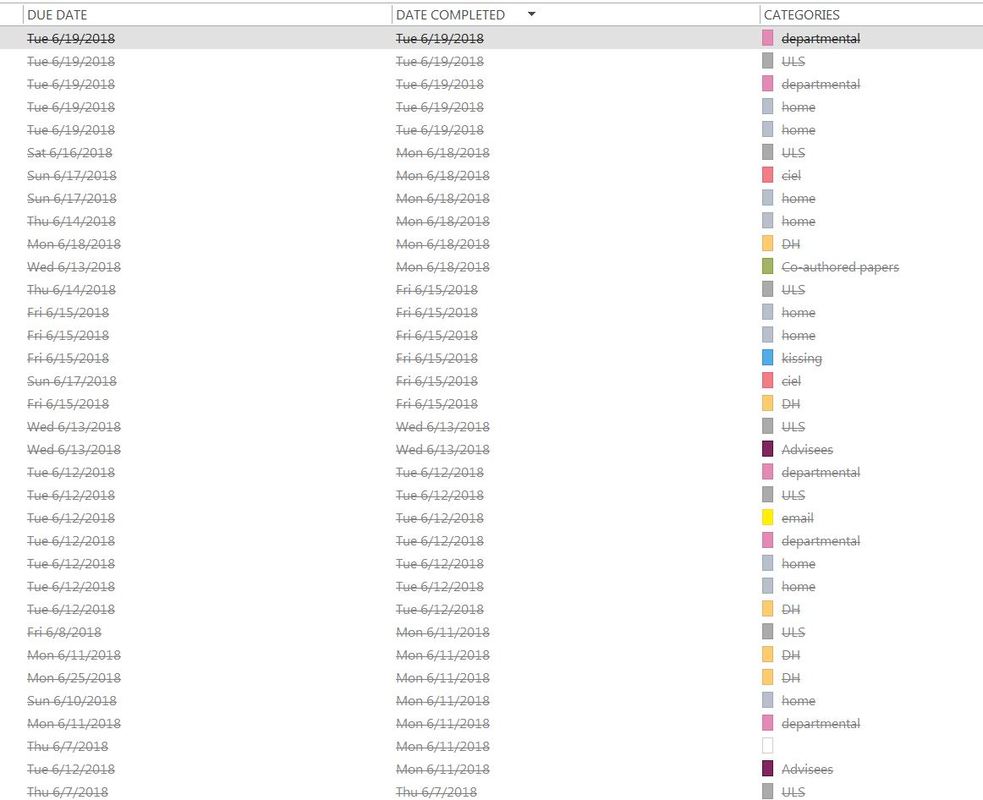
I think that part of the problem is the way we approach tasks. For instance, I use outlook to organize my tasks. Once I complete a task, I have the satisfaction of marking it done in Outlook. But, I don’t then get to look at it my completed tasks regularly. Instead, what I see on a daily basis is all of the tasks I have to do – tasks, for instance, where I didn’t make the deadline so I have to change the deadline to a future date, or tasks that are upcoming. Here’s mine (I’ve removed the specific items):
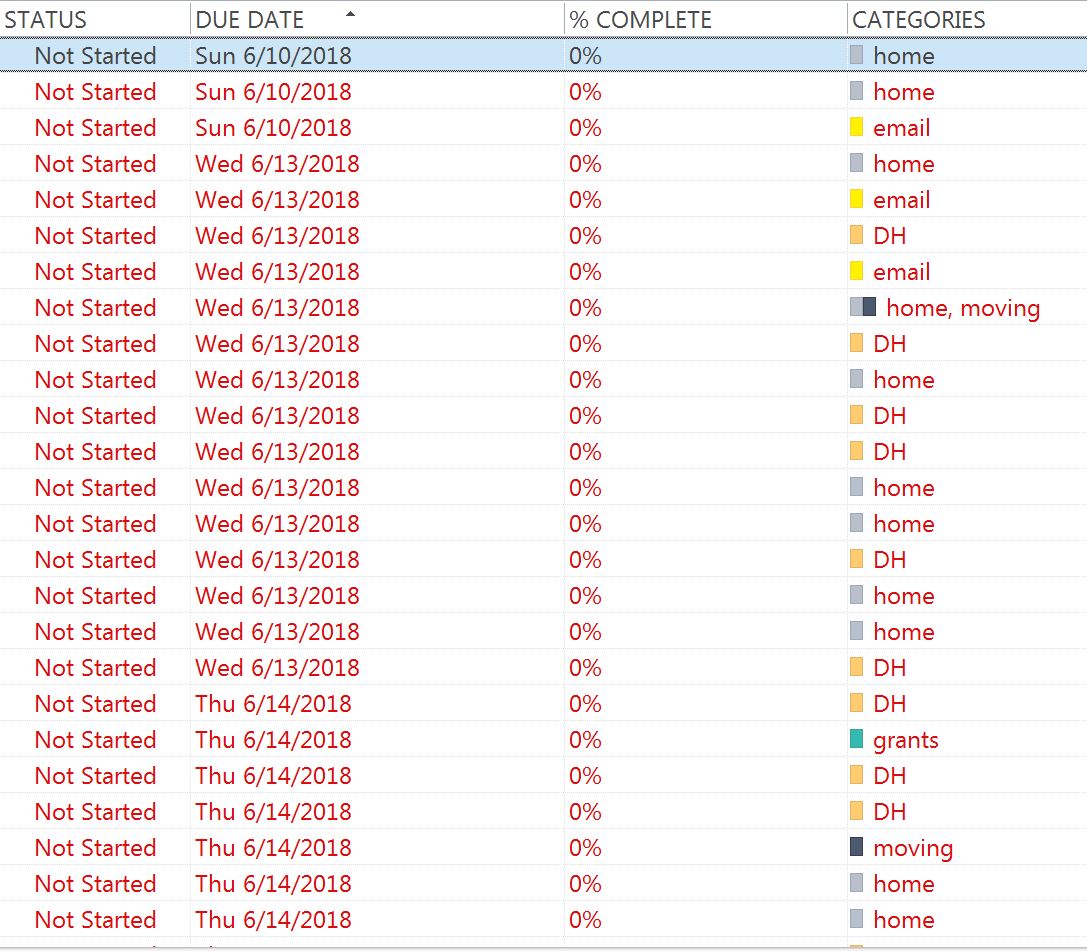
Picture
Picture
It may be that my google spreadsheet of other people’s work in part appeals to me because I can see all of the past work highlighted in green. So, I actually DO regularly get to see the completed part of the denominator when I look at what is upcoming.
 
I’ve thought about this issue recently in my return to blogging, because I have been trying to blog all of my research group’s published papers in the past 3 years (2016 – current). Day to day, I think about the R&R I still have to finish, the former student’s manuscript that’s in my inbox to read, or the paper idea I haven’t made much progress on.  But blogging about recently published papers has been a great reminder of all of the publications in my numerator – I feel as though I’ve written many blog posts on papers, but I’m still working on 2016 papers. A quick skimming of my CV tells me that we have 17 published or in press papers and chapters since 2016. I’m pretty satisfied with that numerator, even if there is a lot remaining in the denominator and in my inbox.
 
I am not sure the most effective way to remind ourselves of our productivity, or all of the things we HAVE accomplished recently. As I mentioned, looking at my CV recently helped me. It also helps me when I have to write an annual report to our Dean about the department’s accomplishments and what I did over the past year. But those big ticket items also fail to capture all of the day-to-day minutiae we accomplish. So, I recommend you figure out a way to remind yourself of your numerator regularly. Yes, we have to focus on the tasks to come, but it can be helpful to remind ourselves of all we have done already.
 
“The Numerator/Denominator Problem of Productivity first appeared on Eva Lefkowitz’s blog on July 5, 2018.”
0 Comments

The sexual double standard lives: How adolescents’ sexual behavior predicts their peer acceptance

7/3/2018

0 Comments

 
Kreager, D. A., Staff, J., Gauthier, R., Lefkowitz, E. S., & Feinberg, M. E. (2016). The double standard at sexual debut: Gender, sexual behavior and adolescent peer acceptance. Sex Roles, 75, 377-392.  

A few weeks ago I described our recent paper that examined when college students do and don’t invoke the sexual double standard to make judgments about people’s motivations for sex. Today I’m writing about another sexual double standard paper with a younger (11 – 16 years old) sample and focused on sexual behavior and peer acceptance. In this study, we used a longitudinal network measure of received friendship nominations to examine changes in peer acceptance based on sexual behavior.
 
In this paper, we demonstrated that, consistent with a traditional sexual double standard, female adolescents who reported having vaginal sex had decreased peer acceptance over time. In contrast, male adolescents who reported having vaginal sex had increased peer acceptance over time. However, these findings did not hold across all sexual behaviors. For instance, the findings for making out showed a reverse double standard. Female adolescents who reported making out (after controlling for sex) had increased peer acceptance over time, whereas male adolescents who reported making out (again, after controlling for having sex) had decreased peer acceptance over time.
 
Thus, findings support a continued sexual double standard among adolescents. Female adolescents can demonstrate their desirability and promote their popularity to male adolescents by engaging in “light” sexual behaviors, but female adolescents who engage in intercourse risk harming their reputation/peer acceptance. In contrast, male adolescents can display their masculinity by engaging in intercourse, whereas light sexual behaviors do not enhance their acceptance. Overall results suggest that in adolescence, the sexual double standard continues to dictate the implications of sexual behavior for adolescents’ peer relationships.
 
“The Sexual Double Standard Lives: How Adolescents’ Sexual Behavior Predicts Their Peer Acceptance first appeared on Eva Lefkowitz’s blog on July 3, 2018.”
0 Comments

Trajectories of gender role attitudes and self-esteem

6/19/2018

0 Comments

 
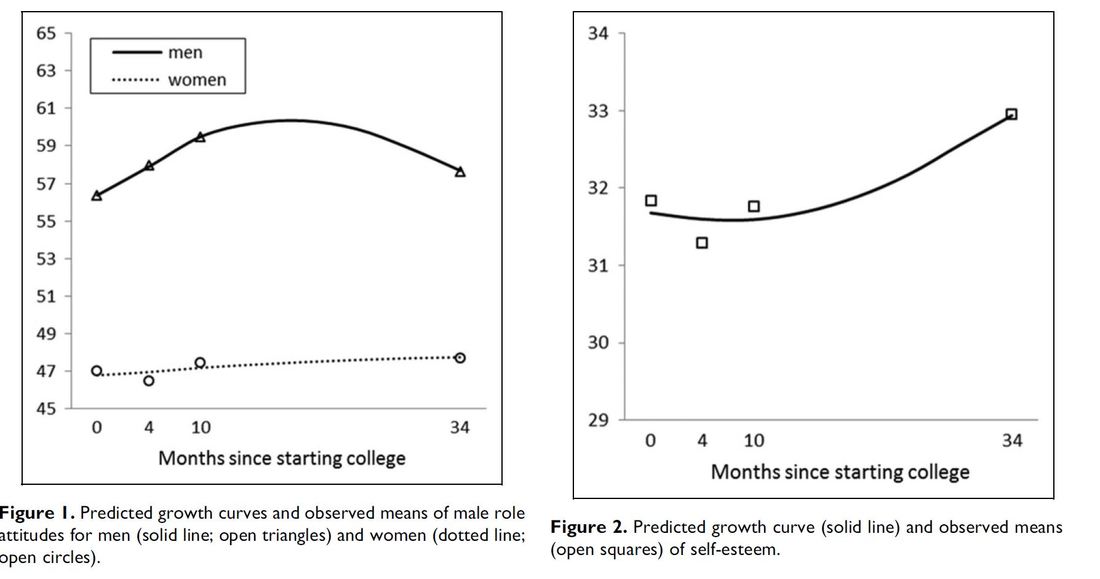
Lam, C. B., & Lefkowitz, E. S. (2016). Male role attitudes and self-esteem: A 3-year longitudinal study of heterosexual college students. Emerging Adulthood, 4, 427-435.
 
Research on masculinity provides useful perspectives for understanding individual development. Two approaches or studying masculinity are a trait approach (the degree to which an individual has characteristics that are considered masculine), and a normative approach (the degree to which an individual agrees that men should have these characteristics). Prior longitudinal research has examined the development and correlates of masculinity personality traits. However, most work on male role attitudes has used cross-sectional data on White men. In this study, we examined developmental patterns of male role attitudes on four occasions over a 3-year period in an ethnically and racially diverse sample. Models revealed that, although men’s male role attitudes became more traditional in the first 2 years of college and then more flexible toward the end, women’s male role attitudes did not change over time.
Picture
 Within-person variation in male role attitudes was negatively linked to men’s, but not women’s, within-person variation in self-esteem. That is, men felt more positively about themselves during semesters when they endorsed more traditional attitudes about male roles. Overall, finding suggest that men may focus on gender typicality early in the transition to adulthood, but that as they gain more romantic experiences in college, they may become more flexible.
 
“Trajectories of Gender Role Attitudes and Self-esteem first appeared on Eva Lefkowitz’s blog on June 19, 2018.”
0 Comments

Giving students feedback in track changes while still teaching them to write

6/14/2018

1 Comment

 
Recently I discussed how I work with students to easily follow the edits they make between drafts. Today I wanted to write about how to provide students feedback in Word in ways that will provide them with scaffolding around writing.
 
In my first year of grad school, I handed my second reader a copy of my masters thesis proposal. About a week later, she returned it to me covered in red ink. She said, that’s the last time I expect you to make any of those mistakes. I’m certain I didn’t magically drop all of those errors in future writing, but I did pay close attention to every word she circled and marked up to figure out what I had done wrong, and to get a sense of how to write better the next time.
 
When I started as faculty I always handed students drafts in hard copy. Usually we would sit together and go through my comments, page by page. I even had a list of editing shorthand that I used, things like AWK for awkward and TS for tense switching.
 
Now I almost always email students a copy of their paper as a Word document with track changes and comments. I have mixed feelings, however, about simply correcting things in track changes. You know how you grade students’ exams, spending substantial time explaining where you deducted points and why? And when you hand them back you realize they are just looking at the grade on the last page? Well, with student theses and manuscripts, I am concerned that sometimes, some students simply accept all of the changes without actually going through and seeing what the suggested changes are, or trying to figure out why I wanted to change it.
 
So, depending on the student and where in the editing process we are, I may handle this process differently. If we are early in our time working together, I try to mark things carefully and write a lot of comments explaining what I think needs to be done. If there are errors that happen frequently, I may correct it the first few times it happens with a note, and I may even write “I stopped correcting these errors after this one. I marked some of them, but you should reread the whole paper carefully for more instances of it.” After that, I either just write a comment (e.g., tense switching) or simply highlight it for them to figure out what the issue is.
 
Similarly, if there is a lot of awkward phrasing, I may rewrite a couple of early ones as examples, and then just start marking awkward phrases/sentences. Or if, for instance, the student is reporting on 10 betas in a regression, and they are all written unclearly, I may rewrite the first one, and tell the student to rewrite the remainder using the one I rewrote as a model.
 
If we’ve been working together for a while, and the student makes an error that I know she commonly makes and I’ve corrected on prior papers (or drafts of this paper), I likely will comment on the first one, explaining it’s another instance of error X that we’ve talked about before.
 
There are times that I don’t use editing as a teaching moment. If, for instance, the student has defended her dissertation (and thus isn’t a student anymore!) and we are trying to get it published, I may spend more time editing the text outright and less time explaining or asking the student to fix things herself. At that point I’m an author of the document as well, so I’m more comfortable with inserting my own writing.
 
Good, clear writing is such a critical skill in academia. We as mentors have to make sure that, no matter what medium we use, we do not treat the editing of student work as if we were a book editor “fixing” things for someone else. Instead, it’s essential that we use this opportunity to teach students how to be better writers.
 
“Giving Students Feedback in Track Changes While Still Teaching Them to Write first appeared on Eva Lefkowitz’s blog on June 14, 2018.”
1 Comment

Attributions of peers' sexual motives

6/12/2018

0 Comments

 
Wesche, R., Espinosa-Hernandez, G. E. & Lefkowitz, E. S. (2016). Gender’s role in misperceptions of peers’ sexual motives.  Sexuality and Culture, 20, 1003-1019.
 
Men and women consider different reasons for having sex, likely in part influenced by the sexual double standard. The sexual double standard also likely influences perceptions of peers’ sexual motives. In this paper, we tested the possibility that perceptions of peers’ sexual motives align with the sexual double standard.
 
Ethnically and racially diverse college students answered three questions about sexual motives. First, they received these instructions:
When deciding to become sexually intimate with someone, people may consider different things such as personal beliefs, partner’s characteristics, how well people know each other or the situation, to name a few.
 
Then, they answered three questions:
Self-motives: What do you consider necessary/most important when deciding to have sex
with someone?’
Male peer motives: What do you think a male student at [name of the university] considers necessary/most important when deciding to have sex with someone?
Female peer motives: What do you think a female student at [name of the university] considers necessary/most important when deciding to have sex with someone?
 
We coded these responses for themes related to male and female stereotyped motives.
 
Supporting prior research, young men were more likely than young women to report male-stereotyped self-motives for sex, and less likely to report female-stereotyped self-motives for sex.
 
As we predicted, individuals were more likely to attribute a male-stereotyped motive to male peers than to female peers and more likely to attribute a female-stereotyped motive to female peers than male peers. In addition, young men misperceived their same-gender peers’ sexual motives in a manner congruent with sexual double standard beliefs, but young women’s misperceptions of their same-gender peers’ sexual motives did not correspond to the sexual double standard. Finally, young women misperceived men’s sexual motives in a manner congruent with sexual double standard beliefs, but young men’s misperceptions of women’s sexual motives did not correspond to the sexual double standard.
 
These findings suggest that when we simply examined perceptions of one’s own motives, or compared students’ perceptions of female peers to male peers, individuals seemed to rely on the sexual double standard. However, when we compared individuals’ own self-reported motives to their perceptions of peers’ motives, both young men and women were more likely to attribute a female-stereotyped motive, and less likely to attribute a male-stereotyped motive, to themselves than to others. Thus, although individuals sometimes rely on the sexual double standard to attribute sexual motives to others, misperceptions of peers’ sexual motives may also be influenced by other stereotypes, for instance, hookup culture stereotypes. These perceptions of the motives of potential sexual partners may influence behavior in sexual encounters.
 
“Attributions of Peers’ Sexual Motives first appeared on Eva Lefkowitz’s blog on June 12, 2018.”
0 Comments

How I gained control of my editing tasks

5/25/2018

0 Comments

 
In Fall 2016, my family had just moved to a new state, and I was a first time department head in a new department. I was busy. But on top of all that, I had three students at my former institution all trying to complete their dissertations by Summer 2017 so that they could graduate with me as their committee chair.
 
All three students had their dissertation proposal meetings during a 3-day period in November. That October was… intense. There were many nights where I didn’t get to the dissertation drafts until about midnight, and I often stayed up until 2:00 or 3:00 AM editing, sometimes from a standing position so that I didn’t fall asleep. I occasionally took breaks to do down dog, again, so I didn’t fall asleep.
 
[I believe it’s important to interject at this point that I adore all three of these students; they all DID finish by Summer 2017, so 4 years for PhD or 5 years for combined masters/PhD; and they all now have awesome positions as assistant professor or post  doc ]
 
Part of the issue was a problem of perspective. I have a general rule that students can expect a one-week turnaround. To each student, they were sending me drafts at a reasonable rate for my response. But, that rate ignored the two other doctoral students; former students sending me co-authored manuscripts; manuscripts to review for journals; my own writing; and of course, every other aspect of my job, and my life.
 
I know I’m not unique in this situation. Part of being faculty is always having to balance one’s own writing, teaching, and service, with editing students’ and collaborators’ work and reviewing grants and manuscripts for external sources.
 
After we got through the defenses, I decided there had to be a better way. So, my students and I came up with a system to get through Spring semester and their dissertations. And the system worked so well, that I have continued the system and use it for the large category of research that I mentally refer to as “other people’s work” even though, of course, I’m often a co-author. I really think it has revolutionized my ability to get other’ people’s work back to them in a timely manner (I’m human though; I definitely slip up.).
 
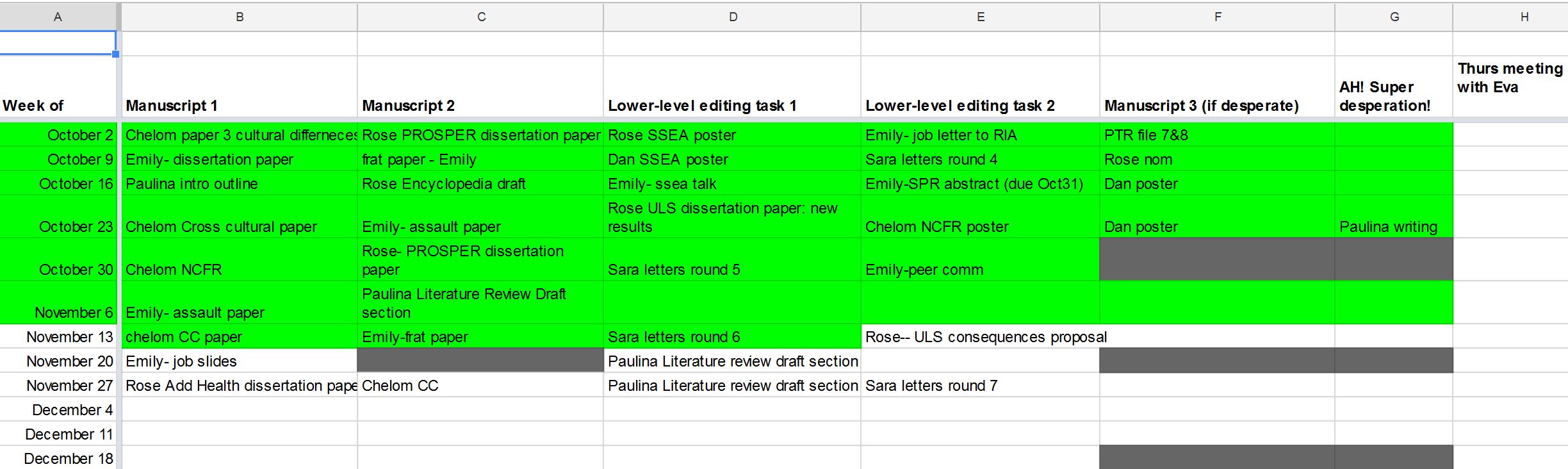
What did we do? We created a google spreadsheet to account for my time. Here’s a screenshot that I took this past November, a few months after everyone had graduated:

Picture
Yes, I have very productive former students!
 
We created the spreadsheet based on my expectations of how much other people’s work I could handle in a given week. I decided that in any given week I could handle 2 manuscript-length editing projects, and 2 smaller editing projects. Recognizing sometimes I needed to do more, I added the “#3 if desperate” column. And, during that dissertation writing semester, we had to add the “super desperation” column, though fortunately we don’t use it much. I also look a few months ahead and black out cells – Thanksgiving week I cut back on the number of things I would edit by blacking out some cells. Spring break I did the same. I blacked out the whole week of our family August vacation.
 
I also defined for students what category they should use:
  • Manuscript: manuscript (co-author or review for journal); chapter of a dissertation or dissertation proposal (if sending multiple chapters, counts as multiple manuscripts); masters or honors thesis; external tenure review letter; dissertation if I’m not the chair
  • Lower-level editing task: conference abstracts; conference poster or talk drafts; job talk slides; job talk materials; up to 10 reference letters to write for set of similar jobs (if applying to 2 different types, e.g., faculty & post docs, count as 2 separate ones); looking at/going over analyses before writing up
 
Students all have access to the editing calendar for months ahead, so they can get on my calendar. This system was extremely helpful during the crazy-dissertation writing semester, when everyone had similar deadlines, and we had to figure out a way to make it all fit, so that I wasn’t reading everything in the same week. It also helped students stick to their deadlines, because they knew if they didn’t get something to me as planned, it might be four weeks later when they could get back on my calendar. I think it also provides students with insight as to what it’s like to be a professor, because they get a better sense of the big picture of what my time use is in terms of other people’s work. In addition to students being able to add their own work into the calendar, I will add things myself, such as manuscript reviews for journals, co-authored papers not by students, and external tenure reviews. 
 
I also have other expectations/assumptions, such as:
  • Assume I am likely to edit any proposal, thesis, dissertation, or manuscript a minimum of 3 times, often more
  • Only use “if desperate” column if truly desperate (e.g., external deadline). Otherwise, use a subsequent week
  • I prefer not to read the same thing 2 weeks in a row, so with multiple rounds of edits on same document, make sure there’s a week off between when I receive them.
 
I know this system is unlikely to work for everyone. It doesn’t always work for me. Sometimes, unexpected things come up and I get a couple of weeks behind (a couple of times I’ve cried uncle and moved everything forward a couple of weeks). Other times I am just really tired and get behind because, for instance, everyone in my life is sick and I want to get enough sleep to try to have a halfway decent immune system. Sometimes, a student misses a deadline and she has to get someone else to swap with her. All that said, in my various administrative roles, I’ve talked to students about mentors who take many weeks and even sometimes months to provide feedback on writing, often slowing down students’ progress through the program or marketability for jobs. This system helps me to stay relatively on track with editing other people’s work, but also, not to let it take over my life. I like that when I get asked to review a manuscript I can look at the spreadsheet and see if I have a slot open in the next 4 weeks; if not, I turn it down. I like that on Sunday night I can look at my week ahead and know what my other people’s work tasks are. It works well enough for me that I wanted to share it with you. If you have a system that works well for you, please feel free to share it in the comments.
 
 “The post How I gained control of my editing tasks first appeared on Eva Lefkowitz’s blog on May 25, 2018.”
0 Comments

Excel tip #1: Counting # of words

3/27/2015

1 Comment

 
Once again, the Internet saved me a couple of hours of my life (of course, it owes me more than a couple -- can we say E M A I L? Thanks a lot, internet!). Oh right, but I was being grateful here.

We have some open-ended data -- participants were asked an open-ended question, and could write as much or as little text as they would like to in response. A reviewer wanted to know how many words were in each participant's response. We have the data in Excel, and my initial, non-elegant idea was to pull it into a table in Word, and then, cell by cell, have Word do a word count.

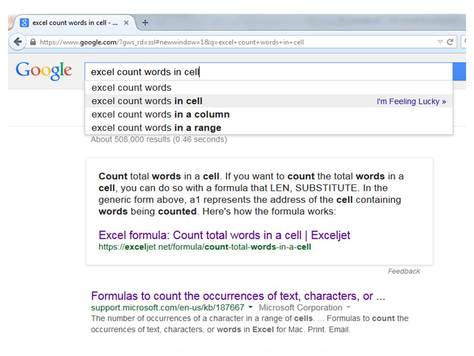
But, google to the rescue:
Picture
The first hit was spot on. I recommend you go to the actual blog post, here, for the formula.  He has good explanations of why it works, so you can cross check it with your needs and make sure it works for you. Here is the formula I used:

=IF(ISBLANK(CD2),0,LEN(TRIM(CD2))-LEN(SUBSTITUTE(CD2," ",""))+1)

I spot checked and everything seems to work out. Thank you Dave Bruns.

"The post Excel tip #1: Counting # of words" first appeared on Eva Lefkowitz's blog on March 27, 2015."

1 Comment

Responsible reporting

2/12/2015

0 Comments

 
Last week in Professional Development we talked about ethical data management. This week we moved to issues with reporting, including data analysis and interpretation. We discussed an interesting paper by John, Loewenstein, and Prelec (2012) in which they surveyed academic psychologists about their engagement in 10 different “questionable research practices” (some of which overlapped with our discussion last week). They told some of the participants that they would be using Bayesian Truth Serum (BTS) – that is, they would use a scoring algorithm to assess the pattern of their scores and determine the honesty of their responses, and then would make a donation to the charity of the participant’s choice based on how truthful their responses were. They did find some differences (based on the algorithm) between the two groups, with the BTS group reporting higher levels of questionable practices than the control group. Our discussion, however, focused more on the percentages of participants who admitted to specific behaviors. It was interesting to see which behaviors students thought were surprisingly high, or were surprised to see on a list of questionable behaviors. It led to a good discussion of whether certain practices, such as not reporting all dependent measures, were questionable/unethical. One student was also very surprised at the rate (43% in BTS group; 38% in control group) of admitting to rounding p-values, and also, in the ratings of how defensible it was to round p-values.

We talked about defamation, and the extent to which it is okay for journalists or researchers to attack researchers in the public domain. And whether there’s a point where it’s okay for the researcher to sue for defamation. We used the Michael Mann case as an example.

We talked about reporting of fMRI data. I confess it is out of my comfort zone to talk about methods for researching fMRI. But we read a paper by Vul, Harris, Winkielman, and Pashler (2009) to spur the discussion. Fortunately, one of my students works with fMRI data, and it was great to have her perspective.

And we discussed some issues to consider in responsible reporting. Such as:

Correcting for number of tests/Type I error.

Statistical significance vs. practical importance/meaningfulness. Studies with enormous sample sizes can demonstrate significant results that, when thought of in effect sizes, are essentially meaningless. On the flip-side, there are sometimes meaningful differences that may not reach the magical .05.

p-hacking/fishing. Gelman has discussed this issue repeatedly on his blog, as have many others. Gelman has also talked about what he refers to as researcher degrees of freedom (decisions made that don’t involve statistical fishing but may still be questionable). I think that fishing is a very common issue in research, particularly with secondary data analysis. It is really useful for students to think about it early on, and to learn how to formulate hypotheses and research questions before running analyses.

Comparing two analyses without statistical comparisons. I have railed about this issue for many years. Gelman and Stern (2006) wrote a great paper called “The Difference Between “Significant” and “Not Significant” is not Itself Statistically Significant” (Yes, I always tell my students not to use article titles in their writing; I make an exception here). The issue is that researchers often say that two things were correlated, and two other things were not correlated, and therefore they are meaningfully different. Or, two things were correlated for one group, but not the other. For instance, maybe parent-child conflict correlated with substance use at .25, p < .05, whereas parent-child closeness correlated with substance use at .22, p > .05. And the researcher/author might then conclude that conflict matters for substance use, but closeness does not. Not okay!  In a paper of mine, I once ran regressions predicting sexual behavior from a set of gendered attitudes, and was interested to see if the gendered attitudes mattered more for men’s or women’s sexual behavior. So I included interactions between each gendered attitude and biological sex. A reviewer then said that I needed to instead run the regressions separately for men and women to see what was significant. That was at least 5 years ago, and I clearly still haven’t gotten over it.

Causal conclusions when not warranted.

I learned the term HARKING.

Preregistration: We discussed arguments for and against pre-registration of hypotheses. And, taking pre-registration a step further, the idea of pre-registering hypotheses AND using simulated data to test hypotheses before actually running analyses in the actual data.   

Students also generated the additional issues to consider:

Treating p < .05 as a magical/meaningful cutoff

How/when to report marginal significance/trend level findings.

“The post Responsible reporting first appeared on Eva Lefkowitz’s blog on February 12, 2015.”

0 Comments

Ethical data management

1/30/2015

0 Comments

 
In Professional Development, we discussed violations of ethical data management, using some high profile examples as case studies (e.g., Hauser, Stapel, Woo-Suk). Instead of having all students read about each case, I assigned each student to read an article about their own case study (see syllabus for exact readings). I think it led to good discussion, where each student could present their case to their classmates, rather than my lecturing about each case, or everyone coming in with the same knowledge base. Many of the cases we discussed were rather glaring/obvious, with entire datasets fabricated or manipulated. But we also talked about fuzzier cases and where one might draw the line. 

Then we talked about best practices in data management. The goal was two-fold – first, recognizing how to avoid violating ethical data management principles. Second, even when you are doing everything ethically, making sure you do it in a way where no one could suspect you of unethical practices. I should be clear that we didn’t try to tackle IRB/human subjects ethical issues this week – we really focused on the data management end of things.

I suggested the following best practices:

Know your collaborators well. This point is important whether you’re talking about mentors, mentees, or collaborators on the same level. In some of the cases we discussed, there were collaborators who were getting or hearing about great data that turned out to be problematic. I’m not saying that the collaborators/students should have recognized the situation sooner – many people have been tricked in similar ways. But the more closely you work with someone, look at data together, and know the person you work with, the easier it might be to recognize problems. In many of these cases, people who had nothing to do with the fabricated or massaged data had publications that were rescinded and thus disappeared from their CVs. That’s a huge deal for someone junior, and you do not want that to happen to you.

Know your own data.
Before you run analyses, look at your data, your means and standard deviations, get a sense of what you have. I don’t mean start running analyses to test hypotheses at the start, but running descriptives, identifying problems with scales or measures… doing these things early can prevent problems later.

Clean data before analyses. No data are perfect. Data have outliers. Data have inconsistent responses. But when do you address these issues? Don’t wait until your results are not significant to poke around and look for data to eliminate. Instead, before any analyses, clean your data. Sometimes participants report they’ve had 20,000 sex partners, or that they’ve had sex 9000 times in the past 3 months. Other times participants answer “1” to every item on a 7 point scale even though some items are reverse scored. It’s acceptable to clean data, or even to throw out improbable data, as long as your decision rules are logical, consistent, pre-determined, and not decided after you test your hypotheses.

Make data cleaning decisions openly.
Be open about the data cleaning process. Don’t make these decisions on your own, and then lose all of the raw data (pesky fires!). Make the decision process public and based on group consensus about how to handle these issues.

Document data cleaning decisions.
Document decision rules, and any cases that were changed from the raw data. Be ready to show someone your decision rules, raw data, and cleaned data, if asked.

Save syntax. All syntax you ever write. One of my students, Rose Wesche, wrote a whole blog post on this point recently, so you can just read what she said.

Analyzing partial datasets.
This is a tough one. There are times when analyzing a partial dataset is highly useful. You want to submit for a conference but your data aren’t all in. I did my job talk on the first half of my dissertation data. If I hadn’t, I wouldn’t have had a job talk. But a risk here is analyzing partial data repeatedly until the results duck under the magical p < .05, and then ending data collection. If you really must analyze a partial dataset, be sure you know what your final N will be, and don’t deviate from it.

Archive data post-publication.
APA says 5 years after the publication. Because many of us publish for many years after publication, it’s important to archive data for many years.

Students generated the following additional ideas:

Write a clear methods section,
so that others can replicate your methods.

Imagine your worst enemy over your shoulder.
Apparently my husband shared this point last year in their methods class – nice to know they listened/retained it. That is, when making data cleaning and analysis decisions, make sure they’re justifiable.

General transparency.

Change the publish or perish culture.
Students were concerned that many ethical violations occurred because of intense pressure to publish in order to succeed and/or obtain tenure. They thought a culture shift would decrease the prevalence of such incidents.

Stress management. Related to the prior point, as individuals, we might not be able to change the culture, but we could work on our own management of the pressures of academia, so that we can make wise/ethical decisions.

What did we miss? What’s important to teach students about being future scientists/researchers?

“The post Ethical issues in data management first appeared on Eva Lefkowitz’s blog on January 30, 2015.”

0 Comments

Grad seminar in professional development and ethics

1/19/2015

0 Comments

 
I'm excited this semester to be teaching, for the first time, a graduate seminar in professional and ethical issues in HDFS. You can find the syllabus here. This course is required for all of our 2nd year graduate students, and partially meets their PSU Grad School SARI requirements (scholarship and research integrity).

My biggest challenge in putting together the syllabus is that I had way too much material. There is so much to cover, and 15 weeks at 1.25 hours per week could not hold it all. I decided that some topics we already cover during orientation and/or their first year orientation seminar, and so those topics would be assumed to be understood (e.g., plagiarism, human subjects & IRB issues). There are also topics, like grant writing and going on the job market, that are very important, but that it's probably too early in their grad school careers to cover in detail, so we have overviews on those topics. I'm trying to line up a grant writing class in future years, and I would definitely consider offering a job market course, although there are multiple constraints in doing so.

In addition, I included in the syllabus a list of additional readings on topics we don't have time to cover.

I gave 6 assignments, which may seem high for a 1.5 credit course. But the students do not have to write any large paper or take any exams, nor do they have to write weekly reaction papers. I designed assignments that are super practical, and that students should be doing anyway, like writing a CV, doing informational interviews with alumni, looking at job listing to start thinking about tailoring themselves for the job market, writing a manuscript review, and setting up a website.

A big thank you to Claire Kamp Dush whose work on putting together similar syllabi gave me ideas for readings for mine.

I still have an open week at the end, so if you have an ethical or professional development issue that you think should be included, let me know!

“The post Grad seminar in professional development and ethics first appeared on Eva Lefkowitz’s blog on January 19, 2015.”

0 Comments
<<Previous
Forward>>

    Eva S. Lefkowitz

    I write about professional development issues (in HDFS and other areas), and occasionally sexuality research or other work-related topics. 

    Looking for a post doc? 
    List of HDFS-relevant post docs
    Looking for a fellowship? 
    List of HDFS relevant fellowships, scholarships, and grants
    Looking for an internship?
    List of HDFS-relevant internships
    Looking for a job?
    List of places to search for HDFS-relevant jobs

    Categories

    All
    Adolescent Development
    Being A Grad Student
    Conferences
    Excel
    Gmail
    Grant Proposals
    Job Market
    Mentoring
    Midcareer
    Networking
    PowerPoint
    Publishing
    Research
    Reviewing
    Sexual Health
    Social Media
    SPSS
    Teaching
    Theses & Dissertations
    Transitions
    Undergraduate Advice
    Word
    Work/life Balance
    Writing

    Archives

    February 2022
    May 2021
    January 2021
    July 2019
    June 2019
    May 2019
    January 2019
    November 2018
    October 2018
    September 2018
    August 2018
    July 2018
    June 2018
    May 2018
    March 2018
    October 2017
    November 2016
    June 2016
    May 2016
    April 2016
    February 2016
    January 2016
    December 2015
    November 2015
    May 2015
    March 2015
    February 2015
    January 2015
    December 2014
    November 2014
    October 2014
    September 2014
    August 2014
    July 2014
    June 2014
    May 2014
    April 2014
    March 2014
    February 2014
    January 2014
    December 2013
    November 2013
    October 2013

    Follow @evalefkowitz.bsky.social on Bluesky

    RSS Feed

    View my profile on LinkedIn

    Enter your email address:

    Delivered by FeedBurner

    Blogs I Read

    Female Science Professor

    The Professor is in

    APA Style Blog

    Thinking About Kids

    Tenure She Wrote

    Prof Hacker

    Andrew Gelman

    Claire Kamp Dush
Proudly powered by Weebly