Find me
THE DEVELOPMENTAL ASPECTS OF SEXUAL HEALTH LABORATORY
  • Home
  • People
  • Research Projects
  • Blog
  • Publications
  • Presentations

Career serendipity

11/27/2018

3 Comments

 
In my adolescent development graduate seminar I once assigned a paper for our identity unit on narrative analysis of turning points (McLean & Pratt, 2006). The authors followed high school students, and about six years later asked them to “write about an important transition or change with respect to their understanding of themselves.” McLean and Pratt consider this event a turning point, and coded the narratives in terms of meaning-making from this turning point, ranging from no meaning expressed to describing an insight from the event. 
 
Discussing this article in the seminar made me realize that at least so far (and it’s been a much longer so far than six years post-high school), I cannot really identify turning points in my life, particularly in the career realm. My How-I-got-here narrative is much more serendipity and process of elimination than Aha! moments or turning points. I’m okay with that path at this point, and actually, I think it’s important to share that path with others. Sharing my own journey to this point with high school students, college students, and grad students can help them to understand that we do not all choose our career based on a critical, life altering moment in childhood, or our lifelong passion since we pretended to be doctors as toddlers. Some of us almost fall into our career path, and that’s okay.
 
I went to college without a major. My father wanted me to be an engineer, so I went to a liberal arts university that did not have an engineering program. My first semester, I took all general education courses – humanities, history, economics, and psychology. I eliminated, three of them, so my second semester I took sociology, political science, fine arts, and another psychology course. For four semesters, I took three courses and a psychology course, until we were required to declare a major, and I declared psychology. So essentially I chose my major through process of elimination.
 
Close to graduation, I decided that I wanted a job in market research, where I could use my research and psychology skills. I spent 2 ½ months the summer after I graduated traveling back and forth to the Brandeis Career Services Center to print my resume and cover letters on fancy paper and apply for market research and marketing jobs. And as time went on, a bunch of other jobs. One of those jobs was as an administrative assistant on a research project at Simmons College School of Social Work. The PI called me to say that the project would soon have a research assistant position available, and that my record seemed more suited for such a position. And so I began a two-year position as a research assistant on a project studying adolescent mental health. My initial reasoning was that I would use the research skills I gained in the job to then be more marketable for market research positions.
 
I really can’t think of a turning point during that first year, but I enjoyed the position, and at some point decided that I wanted to continue in psych research and eventually become a professor. I knew I didn’t want to be a clinician, even though some of the topics that interested me often overlapped with clinical psych faculty’s research programs. So I decided to apply to developmental and social psych programs. I guess that’s the closest I’ve had to a turning point. I actually had trouble writing my grad school application statement because it felt as though there should be a description of a turning point, and I really didn’t have one. I applied to 13 programs, was admitted to five, relatively easily narrowed it down to two, and ended up choosing UCLA over Virginia based on several small factors, mostly from ruling out some things about Virginia.
 
In grad school I had some interest in parent-adolescent relationships, and ended up working with Marian Sigman on a project on parent-child conversations about emotionally charged topics, including sexuality. That’s essentially how I ended up having a career studying sexuality during adolescence and the transition to adulthood – because my interest in parent-adolescent relationships led me to a project that included communication about sex.
 
My large, pre-tenure NIH-funded study on gender roles and sexual behavior? Early in my faculty career, NIH had an RFA on Gender and HIV Risk and I thought, I could pull together a proposal on that. I did, with help of awesome collaborators and students, and it was funded on the first try. My move to UConn and position as department head? Someone emailed me and asked me to apply, and… I did. And here I am. There was (I assure you) no lifelong dream to become a chair or move up the administrative ladder.
 
It is not only my career that has led to serendipity in my life. Take my bridesmaids, given that bridesmaids often represent our closest friends from all periods of life (if, like me, you get married after 30). In addition to my sisters (serendipity in the extreme?), I met my best friend in college because she moved to my dorm floor the second week of classes; we met in the bathroom when I was watering some birthday flowers. I met my best friend in grad school (and long term conference buddy) because we worked in the same lab. And I met my best friend as a faculty member at Penn State at an event scheduled by the New Faculty Club in my first months there, where the youngest people in the room found each other. In fact, many people I met that night continue to be my close friends, even though I have moved away. And, I met my husband when, during my first year as faculty, he interviewed for a position in the same department and a few months later, became my colleague.
 
You may be wondering why I am sharing all of these life details. I am kind of wondering the same thing, honestly. But I think the reason is that a prevailing narrative in our society around career development is to “find what you’re passionate about.” Or, “tell me what inspired you to be a professor” or “when did you know you wanted to be a professor?” (I get asked these latter two frequently by students who are interviewing me as part of a First Year Seminar course requirement). For me, though, there wasn’t a turning point or a lifelong passion. Do I love doing research on adolescent sexuality development? Absolutely. Do I like my job as HDFS department head at UConn? More days than not. Do I think I have the most amazing friends? Can’t imagine life without them. Am I passionate about many of the things in my life? Definitely. But my journey to this point was often serendipitous, and I want others to know that there is nothing wrong with that.
 
“Career serendipity first appeared on Eva Lefkowitz’s blog on November 27, 2018.”
3 Comments

Walk down the hall: The importance of in person meetings

11/15/2018

0 Comments

 
In my first true administrative position, as HDFS undergraduate director at Penn State (well, and honestly, in every administrative position since), I had to send emails. A lot of emails. Like, all the time. Most of the time they were informative - responding to people’s questions, updating people on information. Rarely – very rarely – they were good news. And sometimes, fortunately not that frequently, they were disappointing news in some way. Or, a request that the person may not be happy about.
 
At some point, I had sent an email, I believe making an unpopular request, and received an annoyed response. I brought the email to my supervisor, the department head, to get his advice on how to respond. And he gave me some advice that has been one of the most valuable pieces of advice of my administrative career, and that I’ve relied on in all subsequent administrative positions.
 
In certain situations… don’t send an email. Walk down the hall and talk to your colleague in person.
 
You may be thinking that email interactions are much more efficient than face-to-face interactions. That’s true, to a point. But when the email leads to an interaction escalation, it can actually be much more efficient to talk to someone in person.
 
Here are situations where walking down the hall to talk to someone face-to-face, rather than sending an email, might be beneficial:
  • You have to ask a favor of someone
  • You have negative or disappointing news to share with someone
  • Someone sent you an email, and your reply may not be the answer they want
  • The recipient may misinterpret your email
  • Your colleague might perseverate on your email before you have time to respond to follow up questions (particularly if you have any supervisory authority over the other person)
  • You have been having an email exchange with someone, and the tone between the two of you is escalating in negativity
 
Stopping an escalating email exchange and suggesting a face-to-face meeting instead may be the hardest one to do, because you’ve already started a pattern. When you’ve emailed someone, and they’ve emailed you back something snarky or rude, it’s easy to want to snap back with a response. But this situation might also be one of the most important for changing it to a face-to-face interaction. For instance, a few years ago, when I was grad director, a colleague sent an email disagreeing with a new departmental policy that had been discussed in a faculty meeting. I responded quickly with what I thought was straightforward clarification of the policy (of course, I have no idea how she interpreted the email). The colleague quickly responded with what I interpreted as a snarky email. So I quickly responded, trying, I thought, to deescalate. She then responded with more snark. And then I finally (and later in the interaction than I should have) responded by saying something like, it sounds like you’re getting upset about this policy, and that obviously wasn’t my intent. I think it makes sense if we try to talk about it in person. Do you have any time tomorrow? When we chatted in person the next day, we were both calmer, and admitted that we should have stopped the emails sooner – she said she had gone without dinner, was at a child’s sporting event, and wasn’t in a good place to be discussing a potentially sensitive topic. The face-to-face interaction undid some damage we had started, and transitioning to face-to-face sooner would have probably caused even less negativity between us.
 
Since these earlier experiences, I’ve really tried to have these types of conversations in person, or at least by phone, when possible. My new health strategy of walking the stairs hourly helps in this regard as well – sometimes I bump into someone and can quickly chat about something I want to address, in the stairwell.
 
Sometimes as an administrator, when you show up at someone’s office door, their immediate reaction is “uh oh.” I know when I was on the other side of that door I often had that “Am I in trouble?” gut reaction? That’s why it helps to also pop by people’s offices sometimes just to say hi, or to give good news as well.
 
Email is great for so many things. It’s efficient. It leaves an electronic trail of what was said/asked/promised. You can send it when the rest of the world is sleeping (whether that’s 4:00 AM when you first get up or 2:00 AM before you go to bed). But email lacks many things that face-to-face interaction has, such as facial expression, body language, tone, and the ability to interpret these in your conversational partner. Some conversations really require the subtlety of taking the time to walk down the hall. 
 
“Walk down the hall: The importance of in person meetings first appeared on Eva Lefkowitz’s blog on November 15, 2018.”
0 Comments

How to identify and secure an undergraduate research mentor

11/13/2018

0 Comments

 
If you are in an undergraduate research program, such as your university’s honors college, at some point you likely need to identify a research mentor. It is a huge commitment for you, because if you are doing a thesis, you will be spending about a year of your life reading, writing, and researching for this one paper. But keep in mind it’s also a big commitment on the part of the faculty member. I love mentoring undergraduate students on research projects, but I end up spending significant time across 9-12 months when I do so, so I only commit to it if I think it will be a good fit.
 
How do you identify an undergraduate research mentor? Here are some things to consider.
 
  • What are your research interests? Think about your general interests, and what you might want to spend a year reading and writing about.
  • Visit your department’s faculty research page. Read about the different faculty’s research interests, and see who is doing research that interests you.
  • Ask around. Are there other students who are doing research this year? Perhaps you’re a junior and you know some seniors working on honors theses this year. Ask them for advice on whom to work with.
  • Talk to your honors (or other) adviser. If you chat to them about your research interests, it may help you to narrow down whom you might work with. 
  • Keep in mind that some faculty require that you work on their research projects at least one semester BEFORE you begin your independent research project like a thesis. Therefore, even if you do not plan to graduate in the next couple of semesters, you should consider getting involved in research earlier. I’ve previously discussed other reasons you should get involved in research.
  • Once you have identified one or more potential research mentors, you will need to email them. This email is very important because it is the professor's first impression of you. Please consider my advice when sending this particular email, and also when sending emails more generally:

    1. The greeting.
    You cannot go wrong by starting the email "Dear Dr. Smith" (well, unless you're writing to Dr. Jones; obviously you need to put in the faculty member's correct name). Some faculty are comfortable with being addressed more casually, but others are not. But no one will be offended if you're too formal, and someone could easily be offended by being too casual. Don't risk it with "Dear Firstname," "Hey," "Hi Firstname" or launching right into the message. You might think that “Hey professor” or “Hi professor” sounds respectful, but how would you feel if your professor emailed you with the greeting “Hey student”? The important thing to remember: Most faculty were students and professionals in a time before texting, Instagram, Snapchat, and yes, even Facebook (and for many of us, before email), and are used to more formality in writing. Avoid Mr./Ms./Mrs./Miss. They are almost never appropriate.

    2. Briefly introduce yourself, and why you're writing.

    3. Make it clear that you've done your homework before sending the email. Say something about the work of the person you're emailing, such as "I am very interested in your research on how interactions with parents relate to adolescents' mental health."

    4. Don't assume that someone will immediately agree to be your research mentor. Most of the time, faculty will want to meet you in person, talk more about your interests, and see if it's a good fit.
 
5. Don’t assume that the professor can meet with you in the next few days. Or at one specific time that would be most convenient to you. Ask about general availability to meet, and be flexible about when you can meet.

6. You may also have to be flexible if you have very specific interests, and no one in the department studies that topic. If you email someone and start by saying "I want to do a research paper on sexual predators on social media" and that's pretty far from the professor's own research, s/he may be less responsive than if you describe general interests in social media, or sexuality, and then meet with him/her to discuss it further. Remember, too, that your research paper does not have to be on exactly what you want to do for the next 10 years. You will gain extensive experience and knowledge by working with your research mentor, so be open to other ideas as well so that the mentor relationship can benefit you both.

7. Reread and spellcheck your email! Demonstrate in your first communication that you are a careful and serious student who writes well.
 
These steps will not guarantee that the person you ask will say no. But they will increase your likelihood of a positive response, and make a good impression in the process.
 
“How to identify and secure an undergraduate research mentor first appeared on Eva Lefkowitz’s blog on November 13, 2018.”
0 Comments

Small steps: Walking the stairs once an hour

11/8/2018

0 Comments

 
It was a small moment – in August, in a blog post about reading for grad classes, I mentioned the importance of taking an hourly break for your body. I mentioned that I’m very bad at remembering to take breaks. And I mentioned that I’ve worked with people who set their timer to go off every hour as a reminder to stand up and walk around the building. Finally, I stated, “I will now do the same for myself, so I can practice what I preach. Done.”
 
And I did. For the past month plus (editor’s note: I’m writing this message in early October), just about every day that I’ve been in the office I set an hourly timer that reminds me to get up and walk around. My office is on the first floor, which also decreases my daily movement (though my car is parked ½ mile from my office, so that helps a bit). Now every hour, the timer goes off, I stand up, go up 2 flights of stairs, across the 3rd floor hallway, and then down the other stairs.
 
It isn’t about getting serious exercise. I recognize that 1 ½ minutes around the building is not going to improve my lung capacity, strengthen my heart, build muscle tone, or result in weight loss. But I believe it’s good for me in several other ways. On days that I have a lot of meetings, many of them happen in my office (I have a small table in here) and so I could go many hours without leaving this room. On rare days that I don’t have many meetings, I can end up at my desk without moving for an extended time. So it’s good for my 50-year-old body that I move my joints around every once in a while. It’s good for my 50-year-old eyes that I stop staring at my computer once in a while. And it’s good for my cluttered brain to pull away from whatever is on that computer screen for a couple of minutes every hour. I think it also makes me less likely to get sleepy in the afternoon.
 
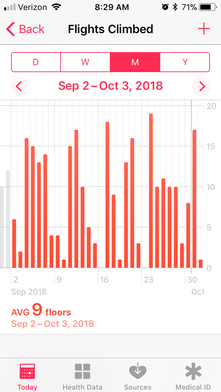
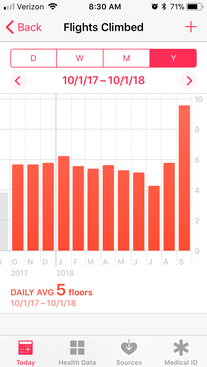
Here is what September, the first full month I tried it, looks like compared to prior months:
Picture
You could interpret this in a few different ways: (a) It’s not that big a difference, only adding about 4-5 flights a day; it’s a huge difference, almost doubling her monthly flights climbed; (c) she sure doesn’t walk many stairs. I choose to interpret it as, on average, I’ve increased 4-5 flights a day, which works out to 120-150 a month, and I call that a win.
 
Another telling image is to think about not averages, but day-to-day variation. So, here is each day in the month of September:
Picture
You can see here that I have a cyclical pattern, walking many more stairs during the week than on weekends (perhaps I need an hourly timer at home, too?) and also, many fewer on Thursdays, which are often my work from home days.
 
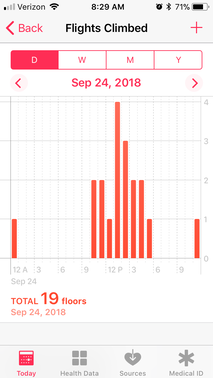
Finally, you can look at what happens on a relatively normal (on the higher than average end) day:
Picture
You can see that most of the stair walking is from 10:00 (after I teach) until about 5:30 (when I leave the office most days), though at home there is also bedtime and… bedtime, sometimes all in the same day. Also note that I often don’t carry my phone around when I’m home so I probably miss a couple of flights of stairs at home.
 
Are there negatives to this new strategy? Not really. I sometimes forget to turn it off before a meeting and it goes off, loudly. In the beginning, I would get questioning looks from my colleagues who know my office is on the 1st floor and weren’t used to seeing me much in the stairway. But look – I’m already the crazy lady who sits on an exercise ball instead of an office chair, so I can handle the puzzled looks. And it gives me more opportunities to bump into my colleagues during the day, which I like. Plus, people are getting used to it and so now, more often than not, someone in the stairwell will say, “oh, are you on your stair walk?” Perhaps I will start a trend and we will all go up and down the stairs together hourly. But even if not, I’m happy to have incorporated this one, very small, very easy modification to my daily routine to improve my overall wellbeing.
 
“Small steps: Walking the stairs once an hour first appeared on Eva Lefkowitz’s blog on November 8, 2018.”
0 Comments

How to read and summarize research articles

11/6/2018

0 Comments

 
Finding articles can be challenging, but sometimes it's even harder to know what to do with them once you find them. How do you go from a 10-page dense article to a few lines in your own literature review or introduction to a study? Although I’ve previously written about what those brief summaries should look like in introductions, today I’m going to provide advice on how to read, make sense of, and summarize for yourself, the content of the articles you find.

Reading the article
Make sure you fully understand the major sections of the article, which generally have an hourglass shape:

a. Introduction. In this section, the authors are describing past work, and how their study fits into past work. When you are writing your own literature review, if you are reading a paper by Brown and Jones, and they cite work by Smith, you should not summarize the authors' summary of Smith and then cite Brown and Jones. If Smith sounds relevant to the paper you're writing, track down Smith and read it directly. When you are reading a journal article for your own literature review, you can use the introduction to find other articles, but you shouldn’t use their summaries of past work for your summary. What eventually will go into your literature review or introduction will focus on the authors’ findings. But, including their conceptual framing and theoretical perspective in your summary for yourself is often helpful.

b. Methods. A description of the sample, procedures, and measures. This section is very useful for fully understanding what the authors did, although you’re unlikely to write much about it in your literature review.

c. Results. An explanation of the statistics performed, and what the authors found. This section is important for learning the main findings of the article. However, many articles use very complicated statistics, and sometimes a reader can get lost in those details. Don't worry if you can't understand everything they did. Focus instead on their explanation of what they found.

d. Discussion. In this section, authors summarize their findings, interpret their findings, link their findings back to the literature, and discuss limitations, future directions, and implications. The summaries in the discussion can be particularly useful if you had trouble following the details in the results section.
 
e. References: This section is very useful for tracking down articles the authors refer to, that are relevant to your own work.

Summarizing the articles
When I write a literature review, I find it helpful to summarize each article for myself in the same way, in one document, so that I can then work with my summaries, rather than the articles. I provide myself enough information so that I don't frequently need to go back to the article. When I do this, I make sure to PUT THINGS IN MY OWN WORDS so I can work from the summaries and know that I am using my words, not the authors'. This point is critical for avoiding unintentional plagiarism. If you think, I’ll just copy and paste, and change it later, when you come back to it a couple of months later, you may not remember you haven’t already put it in your own words.
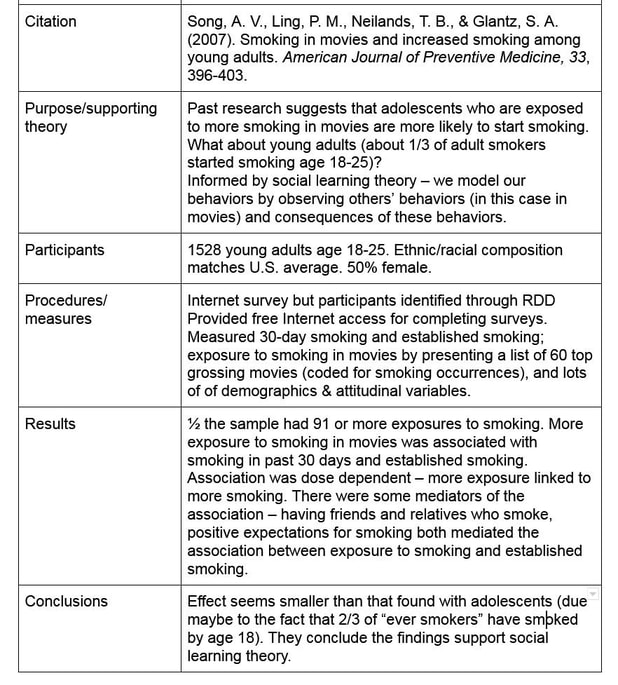
I also want to make sure I have enough detail about the methods so I can easily write it into my paper e.g., I need to know if it was only female participants, only one ethnic group, what age the participants were, etc. Here's an example of one I did:
Picture
Once you have summarized all of your articles, you can then write your own literature review, using your article summaries. I like to start by creating an outline of the full literature review, so that as I add each article to my paper, I can make sure it goes in the correct place. This technique also helps me realize if there are sections of my paper where I have too few articles and need to find more.
 
Having these summaries makes the transition to writing the actual paper so much more straightforward, and saves you time in the long run. And I’m all about efficiency in any way possible.

“How to read and summarize research articles first appeared on Eva Lefkowitz’s blog on November 6, 2018.”
0 Comments

How Zumba made me a better teacher

11/1/2018

0 Comments

 
How Zumba made me a better teacher
 
Karen Kelsky describes how Zumba is an amazing release for her. In Karen’s words, “Dance has given me back to myself.  It’s endorphin-pumping fun, it’s exercise, it keeps me fit, it lifts my depression, and opens up my heart.”
 
Spoiler alert: This post is not about how much I love Zumba. Or how it lifts my depression or serves as a release for me. Instead, it’s about how my ineptitude at Zumba helped me understand my students better.

Before I describe my ineptitude at Zumba, however, it’s important to note that I completely agree with Karen that everyone should find their own thing whether it’s “running, or art, or music, or yoga, or knitting, or walking, or meditation or a hundred other possibilities.” For me, right now, it’s yoga and barre class, and reading/listening to fiction, and Rubik’s cubes.  
 
I have always been a straight A student. How often do I say this? Do I sound like the annoying brainy girl at the desk next to you in math class? I know I say it a lot, but I think it explains aspects of my personality. I don’t think I’m unique here – I know a lot of people in academia can relate. So many PhD students and faculty have similar experiences/personalities. It’s a trait I carry with me into my job. Years ago when I was put in charge of an assessment plan for our department’s undergraduate program, and the previously submitted version received marks of “acceptable,” I immediately launched a 3-pronged approach to assessment to bring us up to “exemplary.” When I do my IRB online quizzes I tend to get 100% on each module (and if I don’t, I’m annoyed). When my son mastered solving the Rubik’s cube, I had to learn how to solve it. And then he mastered the 4X4, and subsequently, so did I. We figured out the 5X5 together.
 
So, I am generally highly motivated to do well, and I generally feel as though if someone teaches me something, I can learn it. But then I took Zumba. I mostly could learn the steps and follow along. But, what I couldn’t do, is look good doing them. I would watch the instructor – who was excellent – and I would try to do the same moves, and they were… not excellent. If you look at the videos in Karen Kelsky’s post – I looked nothing like her. I looked like an uncoordinated 40-something woman trying to do Zumba. Or just like brainy 15-year-old Eva trying to stand in a circle at the school dance with her friends and awkwardly move to the music. Most strikingly, there was an upper body move (which, after much googling, I’ve discovered is called the Reggaeton pump) that looked very cool on the instructor, and very ridiculous on me. No matter how I tried, I could not master that move, even though I felt I was mimicking the instructor.
 
During a Zumba class, I had an a-ha moment. I have had meetings with students, where I am trying to explain a concept to them, that seems very straightforward and clear to me. Negative reinforcement comes to mind. And of course, I believe my explanation is very straightforward and clear. It often seemed like they were working hard in the course, but they still couldn’t do well on the exam, or clearly explain concepts in their paper. And finally, I realized what they must feel like when I try to explain a concept to them. They just couldn’t get it, no matter how much I explained it or how straightforward it seemed to me. Like me and Zumba.
 
It reminds me of Gardner’s theory of multiple intelligences. I know it’s controversial. I know that many researchers have demonstrated that different domains of intelligence are highly correlated, and believe that there is an underlying IQ driving these domains. I don’t dispute those claims. And yet, I also don’t dispute that most of us are not equally talented in every possible domain. That is, even if ability in these domains is generally correlated and linked to an underlying factor, we still may have differential ability across domains. There is no way that everyone is equally talented in every domain. And, we may be more teachable in one area than in another.
 
This realization, this personal realization, definitely helped increase my compassion for students struggling with a concept. Sometimes faculty attribute students’ inability to comprehend to lack of effort. But we as instructors must also recognize that inability to comprehend doesn’t always indicate lack of effort. Sometimes, things that come easy to some of us take enormous effort for others.
 
“How Zumba helped made me a better teacher first appeared on Eva Lefkowitz’s blog on November 1, 2018.”
0 Comments

Good journal article searching habits

10/30/2018

0 Comments

 
When did you master the successful journal article search? During the course of their undergraduate studies, many students have to write a course paper that involves finding primary sources such as journal articles, particularly during junior and senior year. Undergraduate honors students almost always need primary sources for writing their thesis. Graduate students obviously also need to hunt down journal articles for course papers, comprehensive exams, and theses/dissertations throughout their time in graduate school (and after), though some begin graduate school already having developed strong skills in this area.
 
I’ve learned over time that the preparation students receive from their instructor in advance of having to track down articles varies widely. Some instructors fully prepare students for this task, particularly in honors seminars. Others, particularly by graduate school, expect students to know how to perform a successful literature review. So, my advice on how to do an effective literature search may be useful for students toward the second half of their undergraduate career, or early in their graduate career.
 
  • Starting with a textbook: If you’re early in the process – let’s say, trying to narrow down a topic for a review paper for a course or your thesis, looking at your textbook for that course, or other courses, can be useful. Textbook writers spend a lot of time tracking down articles on a huge range of topics.  You can see what articles the textbook cites, and track down those original sources. For instance, if you're interested in sexual behavior, you can look in the sexual behavior section of your adolescent development textbook and track down the papers that the textbook author cited.
  • Review articles: In many areas of research, someone (or multiple someones) has published review articles or meta-analyses. Review articles can be very useful because they summarize a fair bit of past work. However, there is a lot of information in one paper, so you will have to spend a lot more time reading it than an empirical article that summarizes only one study. To find review articles, you can check the titles of articles during your searches for ones that include “meta-analysis" or "review" in the title. The reference list of the review article will help you find other relevant articles (though they obviously will be older than the review article). You can also look at some specific journals that carry review articles, including Psychological Bulletin, Psychological Review, Human Development, and Developmental Review. 
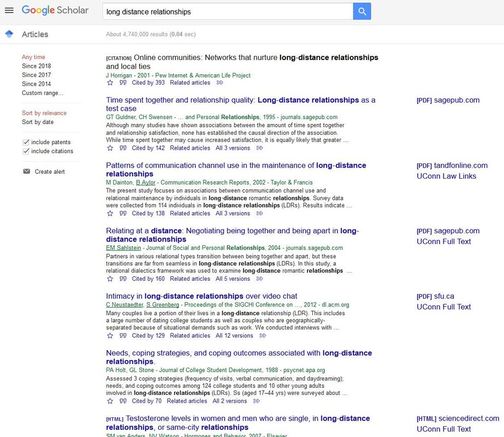
  • Searching in databases: Use Psychinfo, Google scholar, or other journal database to find articles on a specific topic. Learning to choose the right search terms can take time. You may need to spend a fair bit of time practicing and trying out a range of different terms before you find the right articles. If a search gives you < 10 articles, you need broader search terms. If it gives you > 1000 articles, you probably need narrower terms. If you’re using google scholar, using quotation marks can be really important. Let’s use an example. We recently wrote a paper on long-distance relationships. Here are some things I could try:
    • LONG DISTANCE RELATIONSHIPS: Without quotation marks, there are 4,740,000 results. Obviously that won’t work. Though, when I look at the first page, it is clear that they are likely some of the most relevant ones.
Picture

    • “LONG DISTANCE RELATIONSHIPS”: If I put it in quotes, it goes down to 6,760. That’s still probably too many for me to search through. 
    • LIMITS: if you look on the left side of the screen in the screenshot I took, you will see that there are a couple of really quick limits I can set.
      •  Removing “patents” and “citations” doesn’t help much; it’s now down to 6480
      • Years: I have mixed thoughts on limiting searches by year. If I limit to the past 10 years, using a custom range from 2008-2018, it narrows down my results to 4860. That helps, some. And if your instructor or advisor said to only use recent articles, or articles in the past 5 years, or another time-limiting range, then it makes sense to limit that way. But I also fear that emerging scholars are missing a lot of earlier, no less important work by limiting their searches (more on this point later).
      • Additional search terms: I can narrow to a specific aspect of long distance relationships. If I add loneliness, I get 1470 matches. College gets me 3340 matches. Alcohol gets me 973. So, I may be able to narrow down some that way.
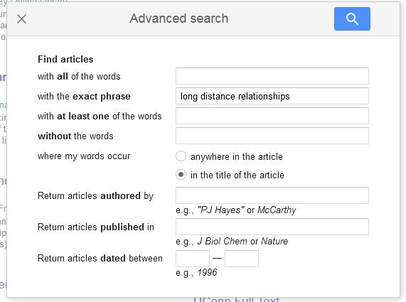
      • ADVANCED SEARCHES: Using the advanced search in google scholar, or using more search terms in psychinfo, can be very useful for narrowing down your search. For instance, if I change the search to be only in the title, it quickly narrows to 178 that use “long distance relationships” in the title. That may be a better starting point than the 6480, because those papers are more centrally about long distance relationships than many of the others that have dropped from the results.
Picture
  • Snowballing: If an article you read cites another article to make a specific point relevant to your interests, look it up. Researchers use this approach a lot.
  • Forward searches: This technique is one of my favorites, because to me it feels like detective work. In psychinfo and google scholar, you can find all the articles that cite a specific article. So, if you find a great article on your topic, you can find all the articles published subsequently that refer to the great article. Some may not be relevant to your topic, but many likely will be.
  • Don’t stop at first page of results: When you do a search, go beyond the first page. I have had students come to me with a reference list where everything was published in the past 2 years, and some are only tangentially related to their topic. The student often then tells me that s/he couldn't find anything more relevant. But often the issue is that the student didn't look through enough of the results in his/her search. When I do a search, I generally look through every article that comes up. That's why you want your search to be specific enough that it produces < 1000. The most recent research may be great, and you want to include the most recent research, but if you're not going more than 2 years back, you're likely excluding a lot of other great research.
Finding the right articles is a critical step to an effective literature review, and will save you so much time later when you are actually trying to summarize others’ work or relate it to your own.  
 
“Good journal article searching habits first appeared on Eva Lefkowitz’s blog on October 30, 2018.”
0 Comments

Intentional writing: Finding-focused, not author-focused literature summaries

10/25/2018

0 Comments

 
I speak a lot about intentional writing, and you can find links to all my prior posts on intentional writing here. The most similar topic to today’s topic is about the importance of integrating, rather than listing, prior studies’ findings.
 
Today I want to talk about the importance of centering your summary of others’ work around the research findings, rather than the authors. I’m going to cheat and use the same example I used previously with slight alterations. Here’s an example of author-focused summaries:
 
Smith, Bogle, Talbott, Grant, and Castillo (2006) found that college students are more likely to drink, and drink more heavily, on their 21st birthday compared to other days. Rutledge, Park, and Sher (2008), in a more representative study, found similar increases in drinking on 21st birthdays. Neal and Fromme (2007) found that alcohol use was elevated on holidays like New Year’s Eve, as well as on football weekends. Similarly, Del Boca, Darkes, Greenbaum, and Goldman (2004) found that alcohol use increases on New Year’s Eve and other holidays. Other researchers have also found elevated rates of drinking on Halloween and St. Patrick’s Day (Glindemann, Wiegand, & Geller, 2007). Patrick, Morgan, Maggs, and Lefkowitz (2011) found that another event, Spring break, also has higher rates of drinking. Finally, Grekin, Sher, and Krull (2007) found that increased drinking during Spring break occurred only when students were with friends.  
 
That paragraph is written so that the authors are the subjects of each sentence, placing the most importance on the author names (or in one case, “other researchers”). However, when you are reading an introduction, you rarely care who did what study (sorry authors! I know you care!). What you do care about is what the authors found. In the occasional instances where, as a reader, you do care about who did the study, the information will still be easily accessible, it’s just not distracting you from the main findings. Here is the passage in the actual paper – much shorter, but without any loss of information:
 
College student alcohol use is known to increase during the celebration of special events such as 21st birthdays (Rutledge, Park, & Sher, 2008; Smith, Bogle, Talbott, Grant, & Castillo, 2006), football games (Neal & Fromme, 2007b), Spring Break (Grekin, Sher, & Krull, 2007; Patrick, Morgan, Maggs, & Lefkowitz, 2011), and holidays like Halloween and New Year’s Eve (Del Boca, Darkes, Greenbaum, & Goldman, 2004; Glindemann, Wiegand, & Geller, 2007).  
 
In the second example, we have integrated the findings across studies, but we also have made the research findings, rather than the author names, the star of the sentence. Which is now one sentence. No information was lost, but the reader comes away with a much better sense of what has been found in this research area.   
 
It probably takes a bit more time to write the second example than the first. But that’s because you are doing the work for the reader, and therefore, it will take the reader a lot less time to understand your points – which should be the goal of writing in any context.
 
“Intentional writing: Finding-focused, not author-focused literature summaries first appeared on Eva Lefkowitz’s blog on October 25, 2018.”
0 Comments

Why you should do a research project

10/23/2018

0 Comments

 
Why you should do a research project as an undergraduate
 
There are a few different reasons why someone might get involved in a research project as an undergraduate student. First, a few students in social science fields (e.g., HDFS, psychology, sociology) already have an inherent interest in research. They seek out involvement in a research project because they are excited about research and scientific inquiry and want to get involved. Second, students in the honors program usually are required to get involved in research at some point, leading up to the experience of doing an honors thesis. These students seek out involvement on a research project because someone told them to. Third, some students want to go to doctoral programs and know that getting involved in research as an undergraduate student is important for their grad school applications. So, they get involved in research to check that box off on their “things to do to get into grad school list.”
 
Even if none of these three reasons apply to you, however, you should seriously consider getting involved in a research project with a faculty member. Often students do so in their junior year, though if you have time to do it as a sophomore, it may open more opportunities.

What do you do on a research project?  Obviously, student research activities can vary dramatically depending on the field, topic, and stage of research. But, these are common activities:
  • Attend meetings where faculty and students talk about research ideas, plan research studies, and talk about research findings and papers they are writing
  • Help with data collection, with activities such as administering surveys, participating in experiments (e.g., performing tests on babies; helping participants with fMRI), calling and/or scheduling participants
  • Help with data entry and data cleaning
  • Code data, e.g., watch videotapes, listen to audiotapes, or watch live to rate participants on different behaviors or characteristics
  • Find research articles on specific topics
 
Why should you participate in a research project if you’re not in the honors program and you’re not thinking about doctoral programs? Or if one of these things is true for you, but you’re not yet a senior?
  • Get to learn more about how to do research, and a particular research project
  • Get to know a specific mentor. At large universities, you may not have many opportunities to talk to faculty, even in your major. When you apply for graduate school or jobs, it can be challenging to find faculty to write you letters of recommendation. But, if you participate on a research project your mentor will get to know you well and will most likely be willing to write a letter for you.
  • If you are planning to do a thesis, starting research earlier in the program gives you a chance to make sure a particular project/mentor is a good fit before committing to a yearlong project like a thesis.
  • If you're planning to go straight to graduate school, you will be applying in Fall of your senior year. If you wait until senior year to get involved in a research project, your mentor will only know you for a couple of months before you ask him/her to write a letter. If you start sophomore or junior year, s/he will know you much better.
  • Participating on a research project often opens up many other opportunities. You may have opportunities to apply for funding in the summer to continue your research. You may get to present your research at an undergraduate (or even local/national) research conference, increasing your networking opportunities and building up your resume.
In the 26 years since I started graduate school, I’ve supervised about 200 undergraduate students in research projects, as many as 24 in one semester. Some of these students went onto doctoral programs and are now professors. Others went onto masters programs to end up as social workers, academic advisors, or sex therapists. Others went into careers that have nothing to do with HDFS and perhaps not research, such as public relations, insurance, or lawyer. During grad school, one of my students started the project saying he wanted to go to a doctoral program in psychology. About a year after he graduated, he sent me a letter saying that watching me as a grad student helped him realize that was not what he wanted to do in life – and he was now a prison guard (yes, we made many jokes about how watching grad student Eva made him turn to an easier life – prison guard). That’s okay – better to realize your preferences sooner than later. Through the years I have gotten to know some of these students well, and have enjoyed watching their lives on social media, and even occasionally attending their wedding. Once, when I was on sabbatical and without childcare, a former undergraduate research assistant, who had become a professor, even offered to hang out with my children so my husband and I could both go to back to school night! 

Your involvement on a research project is often critical to the faculty member or graduate student’s completion of that research project. But it also can be critical to you in multiple ways – figuring out what you want to do career-wise, making connections that will help you later, and getting an enriching experience outside of the classroom.

“Why you should do a research project first appeared on Eva Lefkowitz’s blog on October 23, 2018.”
0 Comments

How to gather useful information from student evaluations of teaching

10/18/2018

0 Comments

 
*Side note: My blog had been rather neglected for the past 2 years. I always have good intentions, but they rarely translate to finding the time to write here. This summer, for whatever reason, I found the motivation to regularly open up my file of “future blog posts” and sit down and write them. In almost exactly three months (5/25 to today, 8/26), I wrote 42 posts, 27 posted for three months, twice a week, and another 15 scheduled to post through 10/16 (this one I’m writing right now for 10/18 makes 43).  That’s a lot of writing time, and one might argue that I could have written one or more manuscripts in the time I spent writing blog posts. But it’s debatable whether I would have used the time as effectively if it was manuscript-focused time. And, at some point in your career, you can take a bit more freedom to make choices, such as being generative in different areas than the traditional ones. I recognize, though, that I cannot write nearly as frequently during the academic year. So, perhaps my posts will continue beyond mid-October, but if there’s another hiatus, thanks for coming along for the ride and I hope you found something useful.
 
And now, student evaluations of teaching. I will refer to them as SETs which is what they are called at UConn.
 
The first time I received student evaluations of my teaching I was a graduate student TA for a section of research methods. I called a friend and told her I was sad because I had a really negative review. She said, really, I had great reviews! And after we talked for a while, we figured out that both of us had mostly positive feedback with 1-2 negative people in the pile, it was just that I perseverated on the negative one and couldn’t remember the positive ones, and she ignored the negative and focused on the positive.
 
I still find it hard not to perseverate on negative feedback in my SETs. I think it’s because the most negative ones are generally the most strongly emotionally valenced, and so they are the most memorable. At least to me. I really want to take student evaluations into account when I revise my course each year. But I find that if I’m not careful, those highly emotionally valenced ones may sway my view. I have even at times changed a course in response to such a review, having then the next year more students complain about the new format.
 
SETs don’t have the same meaning for me now that I am post-tenure, post-full professor. Previously it at times felt like SETs were linked to job security. Now, to be honest, as long as I don’t get scores low enough to raise eyebrows in the Provost’s Office, no one is going to care much about my SETs.
 
All that said, I do want to learn what students did and didn’t like about my courses, and figure out how to improve them. I had a colleague who prided himself on never looking at his teaching evaluations. I’ve had other colleagues who, when I was Undergrad Director and met with them to discuss lower ratings, would blame it all on the students, such as, “this was such a bad bunch this semester.” I can’t quite understand that. I don’t think we should bend over backwards to please students all the time, but I do think we need to consider students’ perspective on the course.
 
When I was Undergrad Program Director, I often had to help other faculty interpret their SETSs and figure out how to respond to them in course design. During this process, I developed a way to summarize the SETs for others, and I now use that technique with my own SETs. If you teach a small graduate course, you may find this technique less useful. But if you have a large course like mine, then summarizing them may help you find patterns.
 
Essentially what I am doing is coding the responses. I pull up the open-ended responses, open an Excel file, and read through them one at a time. For each one, I try to code or categorize any unique point that person says. I keep a running tally of each point, so that the second time someone says “she was so enthusiastic!” I don’t make a new line, I just add a count to the line “enthusiastic/energetic/engaging.” I do separate summaries for “Most positive aspects” and “What can instructor do to change.” Once I’m done coding, I sort them by # of responses in descending order, and I can much more easily see the patterns and get a sense of the overall student perspective, rather than only remembering the most strongly worded ones.
 
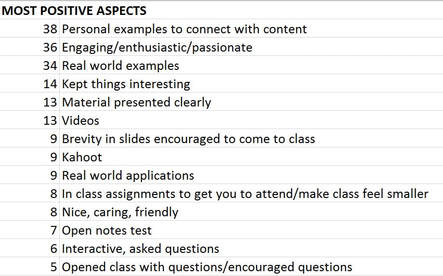
This year, when I first received my SETs for my 290 student class at the end of the semester, I skimmed them but didn’t take the time to read them. The sense I came away with from them was that they overall liked me and thought I was enthusiastic, but that students also were unhappy that I made them do group assignments because the class was a mix of freshmen – seniors; unhappy that instructor seemed unsure of herself; and unhappy that I relied on my notes too much. But when I tabulated, those last three points were literally each from one person – in a class of 290. That’s what I remembered the most, though. So instead, when I tabulated them, I could much more easily see the trends. Here are all of the answers to the question about “most positive aspects” that 5 or more students made:
Picture
`So I get a clear sense that students like that I gave lots of personal examples, and real world examples, and students found me engaging/enthusiastic/passionate. All of these positives even won out over showing videos, so I take that as a strong win.
 
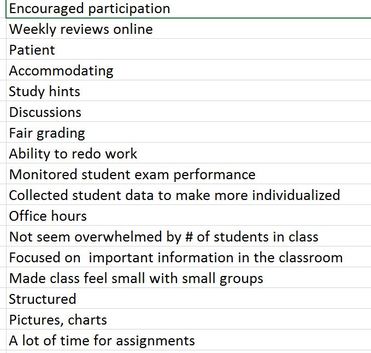
Toward the bottom I can see the things that only one student mentioned as a positive:
Picture
These are things that might make me feel good in some cases, but I don’t have to spend a lot of time thinking about them, either.  Now, here are all of the things that 5 or more students said I could do to improve the course:
Picture
I’m feeling quite good that the most common response was for students to say “nothing” or “N/A” or “I can’t think of anything.” After that, I’ve highlighted for myself the next most common things that students said. Lots of students would like me to have more detail in my notes. That’s something that I’m not willing to change, because there is research on learning and memory to support my decision to have PP slides without a lot of detail, forcing students to pay attention and take better notes. In fact, 9 students said they liked the brevity in my slides. My best guess is that most of the students who asked for more detail in my slides were among the students who attended class infrequently, and they want me to post notes on Blackboard that have enough information that they didn’t miss anything. I’m not going to do that, but I can spend more time on the first day of class this semester explaining why my notes are the way they are.
 
Some students thought my (open-notes, open-book) exams were tricky. And some students thought I should be more clear about what exams would be like and what would be on exams. So I can probably spend more time in class pointing out some of the concepts that students find tricky, and talking about how to use the weekly review questions I post. A lot of the things I got out of this section of my SET’s are about ways I can help the students understand what is happening in the course, rather than changing my policies per se. But there definitely have been times that I have read something in my SET’s that has made me make some more radical changes in my course.
 
This technique has really helped me take the emotion out of reading my SETs, so that I can concentrate on what students do and don’t appreciate about the course, and respond appropriately. How do you deal with student evaluations of teaching?
 
“How to gather useful information from student evaluations of teaching first appeared on Eva Lefkowitz’s blog on October 18, 2018.”
0 Comments
<<Previous
Forward>>

    Eva S. Lefkowitz

    I write about professional development issues (in HDFS and other areas), and occasionally sexuality research or other work-related topics. 

    Looking for a post doc? 
    List of HDFS-relevant post docs
    Looking for a fellowship? 
    List of HDFS relevant fellowships, scholarships, and grants
    Looking for an internship?
    List of HDFS-relevant internships
    Looking for a job?
    List of places to search for HDFS-relevant jobs

    Categories

    All
    Adolescent Development
    Being A Grad Student
    Conferences
    Excel
    Gmail
    Grant Proposals
    Job Market
    Mentoring
    Midcareer
    Networking
    PowerPoint
    Publishing
    Research
    Reviewing
    Sexual Health
    Social Media
    SPSS
    Teaching
    Theses & Dissertations
    Transitions
    Undergraduate Advice
    Word
    Work/life Balance
    Writing

    Archives

    February 2022
    May 2021
    January 2021
    July 2019
    June 2019
    May 2019
    January 2019
    November 2018
    October 2018
    September 2018
    August 2018
    July 2018
    June 2018
    May 2018
    March 2018
    October 2017
    November 2016
    June 2016
    May 2016
    April 2016
    February 2016
    January 2016
    December 2015
    November 2015
    May 2015
    March 2015
    February 2015
    January 2015
    December 2014
    November 2014
    October 2014
    September 2014
    August 2014
    July 2014
    June 2014
    May 2014
    April 2014
    March 2014
    February 2014
    January 2014
    December 2013
    November 2013
    October 2013

    Follow @evalefkowitz.bsky.social on Bluesky

    RSS Feed

    View my profile on LinkedIn

    Enter your email address:

    Delivered by FeedBurner

    Blogs I Read

    Female Science Professor

    The Professor is in

    APA Style Blog

    Thinking About Kids

    Tenure She Wrote

    Prof Hacker

    Andrew Gelman

    Claire Kamp Dush
Proudly powered by Weebly